

Modernizing high-risk systems in the age of AI.
Stop Moving Faster and Start Moving Forward
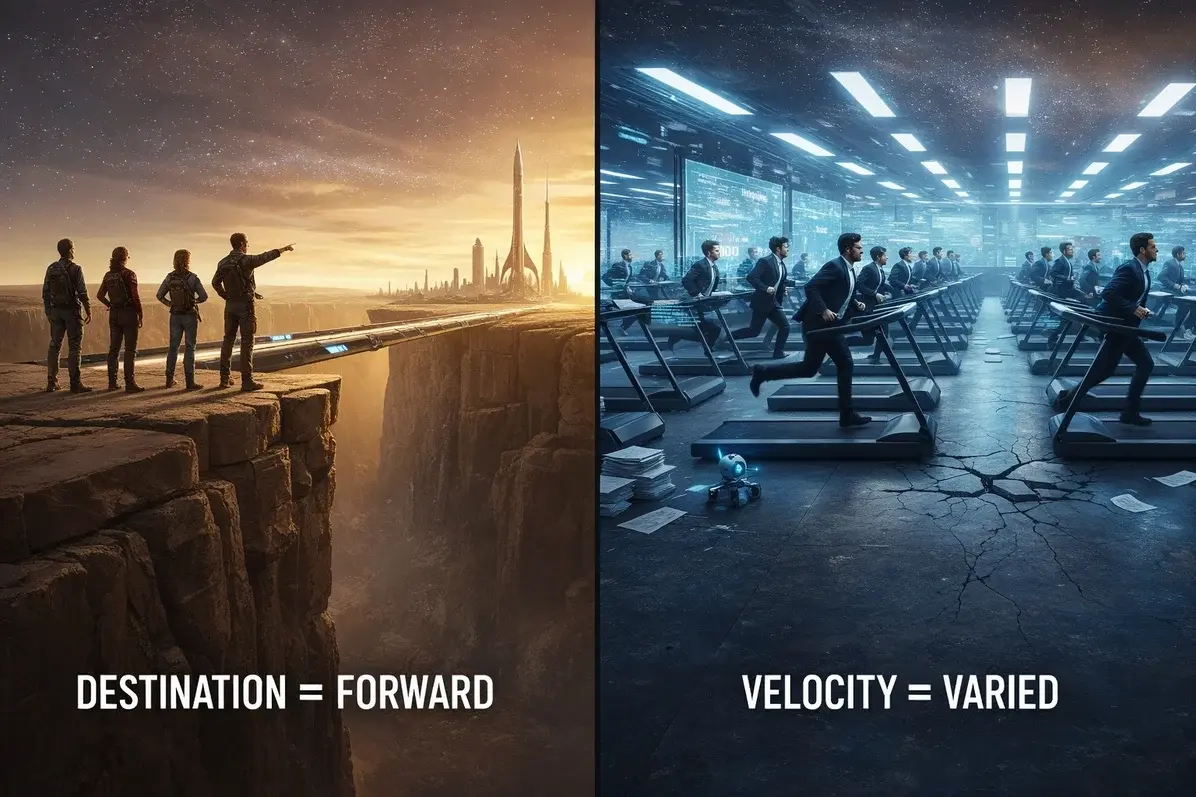
When everyone gets faster, faster becomes the floor—not the ceiling

Founder, Def Method
In a recent Wall Street Journal article, we're told that many companies plan to stay flat or trim staff this year. The unspoken assumption is familiar by now: AI will make up the difference.
In engineering, we already know how this story goes. When everyone is told to "do more with less," that output quickly becomes the minimum bar for competence. It's no longer a competitive edge. It's table stakes.
If your team stays the same size, adopts generative AI, and suddenly produces 160% of the code they did before tools like Claude Code existed, congratulations. You're keeping up. You are not winning. And you will lose to the companies that use their resources not just for efficiency, but for ambition.
Let's Make This Concrete
Imagine you run a team of ten engineers. A year ago, none of them were using AI coding agents at scale. Today, they're all "experts"—meaning they've had a few months of real usage under their belts and they're shipping code at a pace that would've been unthinkable last year.
At first, it feels incredible. Then the bottlenecks show up.
You still have ten engineers. Nobody suddenly has more hours to review pull requests, so review becomes the constraint. Policies loosen. You lean more on AI-powered code review tools. Some of them are genuinely good.
But volume has a way of overwhelming safeguards. More bugs make it to production. More features slightly miss the mark. Not because your team is careless or unskilled—they're actually quite good with AI—but because there is so much more of everything. More code. More surface area. More edge cases. More ways for small mistakes to compound.
Despite best efforts, the team spends more time in production support, less time building new systems, and more time maintaining the velocity they just unlocked.
The Uncomfortable Part
This isn't a failure case. This is success.
Every other engineering organization is doing the exact same thing. Your competitors are shipping faster, too. They're delighting and frustrating customers at roughly the same rate you are. From the outside, the market looks flat again. It's just operating at a higher RPM.
For the owner of the business, that's a problem. The business owner is looking for an edge. So leadership reaches for the only remaining levers: ship even more of the roadmap, or cut expenses.
The Alternative
Option (a) leads to chaos. Option (b) leads to a smaller team expected to maintain the same pace. Most companies already know how this ends—and most will do it anyway.
But a few organizations won't. A few will invest in a down market when engineering talent is available and competitors are retrenching. A few will resist turning AI into a pure cost-cutting tool and instead use it to unlock work that was previously uneconomical, too risky, or too ambitious to attempt.
Those are the companies positioning themselves for what comes next. Because everything we "know" about AI in this new world is less than five years old. And the only certainty is that we're still early.
Ready to modernize your Rails system?
We help teams modernize high-stakes Rails applications without disrupting their business.
If this was useful, you might enjoy Essential Complexity — a bi-weekly letter on modernizing high-risk systems in the age of AI.