Modernizing high-risk systems in the age of AI.
Creative Ambition's Call to Arms
The history of automation isn't about replacement—it's about expansion
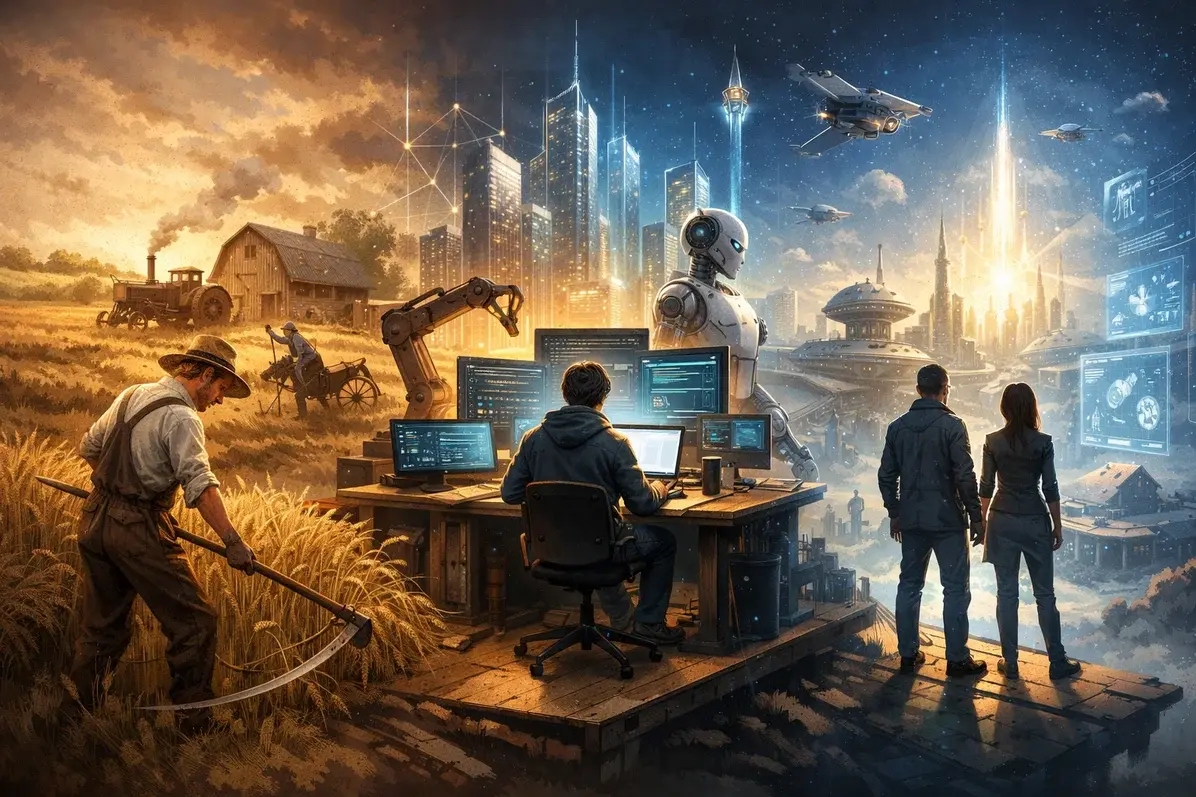

Ben Thompson recently wrote an excellent piece on Stratechery about AI and the human condition. One section, in particular, has stuck with me:
In 1810, 81% of the U.S. population worked in agriculture. Then came the second agriculture revolution, such that 200 years later only 1% of the U.S. population works in agriculture... humans were replaced by machines, even as food became abundant and dramatically cheaper.
Thompson goes on to state that the dramatic drop in food prices and exit of humans from agriculture eradicated neither jobs nor farming:
That's because humans didn't just sit on their hands; rather, entirely new kinds of work were created, which were valued dramatically higher... the history of humans is the continual creation of new jobs to be done—jobs that couldn't have been conceived of before they were obvious, and which pay dramatically more than whatever baseline existed before technological change.
That whole article is worth reading, but this passage dovetails with a theme I keep returning to in conversations across tech: automation is rarely a zero-sum game, even when it feels that way in the moment. Yet in software development, we keep treating it as if it is.
The Failure of Imagination
I often hear the claim that AI code generation will eliminate junior engineering roles because so much "rote" programming is now automated. What's striking is how rarely anyone follows that logic to its conclusion.
If we stop bringing new people into the profession, software engineering doesn't evolve, it atrophies. A field that can't regenerate itself doesn't get more efficient; it simply disappears.
That framing also sells our industry short. Historically, every major productivity leap in software has done the opposite of shrinking the discipline. Higher-level languages didn't eliminate engineers. Frameworks didn't eliminate engineers. Cloud infrastructure didn't eliminate engineers. Each shift removed a layer of friction and, in doing so, expanded what was economically and technically possible to build.
AI is no different.
The Wrong Questions
What is different is our collective imagination. Instead of asking, "What new kinds of systems become possible now?" we ask, "How many people can we do without?" Instead of exploring new responsibilities, new abstractions, and new forms of leverage, we argue over which existing roles are about to vanish.
That's a failure of ambition, not technology.
Why wouldn't we expect the frontier to move again—beyond what we can clearly articulate today? Why wouldn't we expect software engineers and technical leaders to be the ones defining that frontier, just as they have for decades?
Is it fear? Fatigue? Or have we simply grown accustomed to thinking smaller than the tools we're building?
Coming Back to Our Senses
I think we're starting to come back to our senses. New uses for technology are already emerging, and they're not all coming from the obvious players. That's a good thing. Progress has always depended on outsiders, risk-takers, and people willing to build before the playbook exists.
We don't need perfect certainty. We need momentum, curiosity, and the willingness to work at the edge again.
The tools are already here. The opportunity is visible. What's left is the decision to build further than before.
Need to modernize a high-stakes system?
GUIDE is Def Method's framework for preserving understanding, strengthening governance, and building evidence before implementation accelerates.
If this was useful, you might enjoy Essential Complexity — a bi-weekly letter on modernizing high-risk systems in the age of AI.