Modernizing high-risk systems in the age of AI.
The Platform Illusion: Why AI Won't Save Incremental Software
Being a 'platform' won't protect you from AI disruption—only architectural courage will
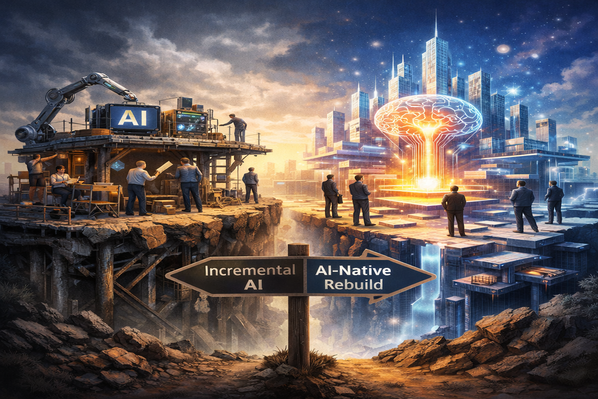

You don't need a Wall Street Journal subscription to know the markets have been volatile lately. AI may not explain everything, but it's clearly shaping investor psychology around large software companies. There's a narrative forming:
- If your company does one thing, you're in trouble. AI can now do that one thing.
- If you're a platform, you might survive. Enterprises are slow to rip things out.
- If you're a platform that "embraces AI," you might even thrive.
While this argument is concise and compelling, it lacks subtlety in two important ways.
1. It Assumes the AI Utility Layer Is Already Settled
A silly offshoot of the "software companies are doomed" argument is the silent acceptance that OpenAI and Anthropic have already "won." As if businesses will replace every SaaS product it has with an executive's vibe-coded prototype or with whatever OpenAI ships next.
But vibe-coded work is not a scalable system. It's a prototype.
And OpenAI can't even build a suitable interface for its own chat product. It's not replacing your SOC-2 compliance stack by itself. Lurking beneath this argument is something bigger: the idea that OpenAI and Anthropic should now be treated as utilities, like electricity. As if the game is over at the infrastructure layer.
That's a dangerous assumption. We are barely in the first act of infrastructure buildout:
- Model providers are still evolving.
- Tooling ecosystems are immature.
- Reliability patterns are not standardized.
- Cost structures are volatile.
- The integration surface area inside enterprises is enormous.
Treating AI like electricity right now is like treating the internet like electricity in 1997. Utilities don't emerge in chaos. They emerge after architectural consolidation.
2. It Underestimates What It Takes to Build Truly Complex Systems
In what is fast becoming a theme in 2026, we've also uncovered an imagination gap. People assume the future will look like: "Old software, but with AI inside it."
That's the Salesforce instinct. Marc Benioff launched AgentForce roughly nine seconds after AI took over the news cycle. What does it do? How does it work? Those questions barely matter. It's AI! It does AI things!
Fast forward to 2026. AgentForce hasn't meaningfully moved the needle.
That's because it's an AI layer grafted onto a mature, revenue-optimized platform. It makes workflows marginally better. It improves reporting. It automates some tasks. It's incremental.
If you've been reading this newsletter, you know I have a big bet against companies that use AI for incremental gains. AI is not a feature. It's an architectural shift. And architectural shifts don't reward companies that simply bolt them onto existing abstractions. They reward companies that:
- Rethink the system from the ground up.
- Rebuild workflows end-to-end.
- Use AI not to optimize the old constraints but to remove them.
That requires building new, complex systems—not marketing campaigns.
The Real Divergence
Right now, only a handful of established companies are attempting truly ambitious AI-native systems.
But what's interesting is that the market knows there's ambitious plays to come. That's why we're seeing:
- Capital pulling back from incremental players.
- Skepticism toward "AI-powered" add-ons.
- Volatility around incumbents who look reactive rather than transformative.
The market is pricing architectural courage—and capital will be deployed for those businesses that demonstrate it.
Why This Is an Opportunity for Builders
If you're a business or technical leader right now, this is your moment. Capital is retreating from companies that are doing the same old thing, even when they're doing the same old thing very well.
That creates space for:
- Companies willing to redesign systems instead of decorate them.
- Teams that can build complex, integrated infrastructure.
- Leaders who understand that AI gives us an opportunity to rethink how software is structured.
Most organizations won't take that risk. But the next wave of durable companies won't be the ones who "added AI." They'll be the ones who rebuilt around it.
Need to modernize a high-stakes system?
GUIDE is Def Method's framework for preserving understanding, strengthening governance, and building evidence before implementation accelerates.
If this was useful, you might enjoy Essential Complexity — a bi-weekly letter on modernizing high-risk systems in the age of AI.