

We're Still Catching Up to Global Teams
It was the shift to global teams—and most organizations still don't have a framework for doing it well

Founder, Def Method
For the last three years, almost every conversation in the software world has revolved around one topic: "What is AI going to do to engineering teams?"
But after 20 years working inside engineering organizations, I can tell you this: AI is not the force that has most reshaped how we build software. (At least not yet.)
The real transformation happened quietly, starting in 2020.
The Quiet Shift
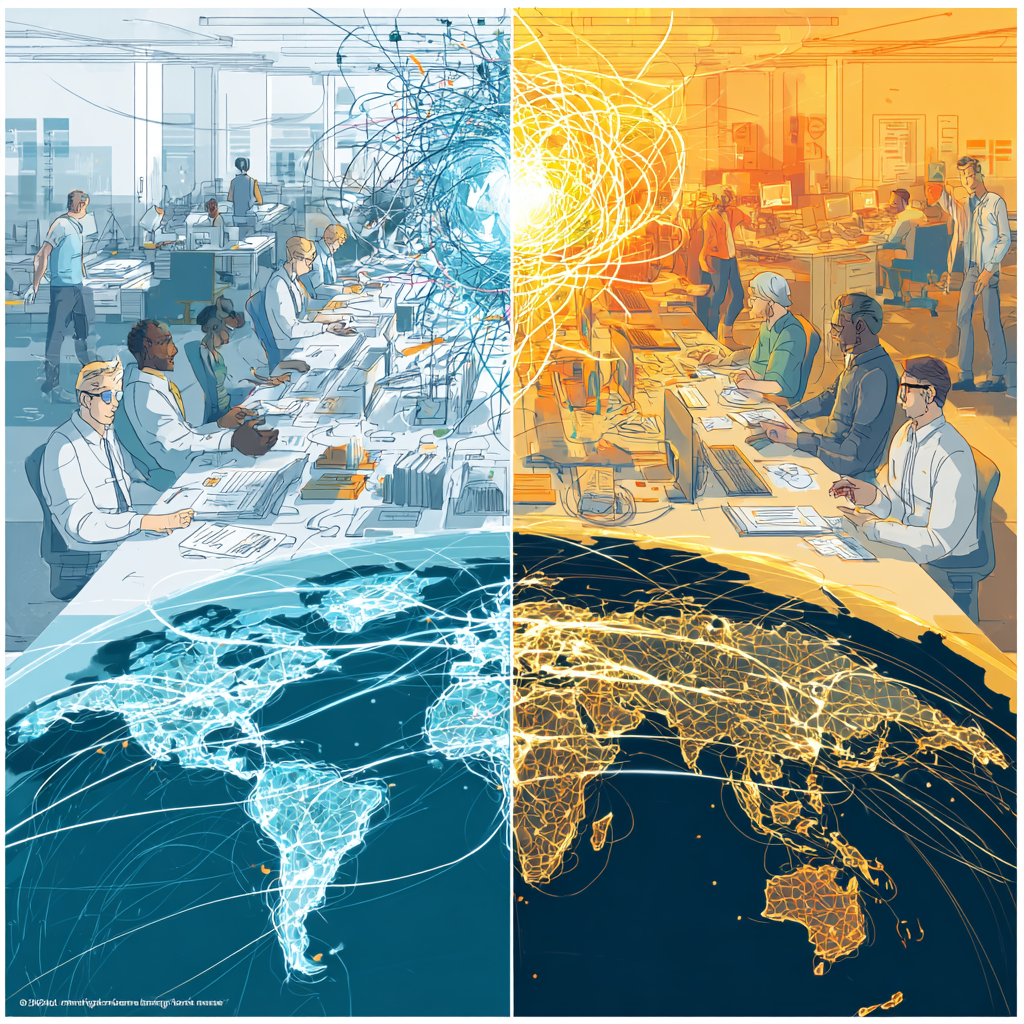
Suddenly, everyone became a global team. This meant engineers in five time zones, people working asynchronously, and product, engineering, design, and delivery teams scattered across continents.
It became normal so fast that we underestimated the impact. But most engineering failures I see today are not AI problems. They are global coordination problems.
Gaps in requirements become chasms across distance. Missing architecture becomes rework. Ambiguity becomes stalled roadmaps. Lack of clarity becomes costly misalignment.
Global talent is an incredible advantage, but only when the work is shaped, scoped, and led with precision.
Today, AI accelerates engineering, but global work has fundamentally changed it. And most organizations still don't have a framework for doing it well.
A Company That's Been Doing It Right—UPSTACK
Long before the pandemic, before global engineering was the norm, UPSTACK was already operating as a distributed, multi-team organization. They understood something early: Distributed teams only work when the direction is crystal clear.
When UPSTACK hired Def Method, it wasn't because they couldn't execute. It was quite the opposite. Their execution was strong. What they needed was validation and clarity before investing millions into the wrong feature set.
In a 6-week Product Discovery sprint, we conducted user and stakeholder interviews, uncovered deep pains around IT inventory visibility, validated the real drivers of user retention, designed and wireframed a solution, and estimated the MVP scope and long-term roadmap.
The insight we surfaced was simple but powerful: UPSTACK didn't need to build faster—they needed to build the right thing.
That clarity became the foundation for a decade (and counting) of successful distributed product development.
How Global Engineering Should Work
UPSTACK is a model of how global engineering should work: strong local leadership, clear product strategy, validated direction, and execution distributed across teams only after alignment is achieved.
If you're navigating global or hybrid engineering teams, the lesson is clear: the work that happens before coding—shaping, scoping, aligning—is what separates teams that scale from teams that spin.
See It in Practice
Ready to modernize your Rails system?
We help teams modernize high-stakes Rails applications without disrupting their business.