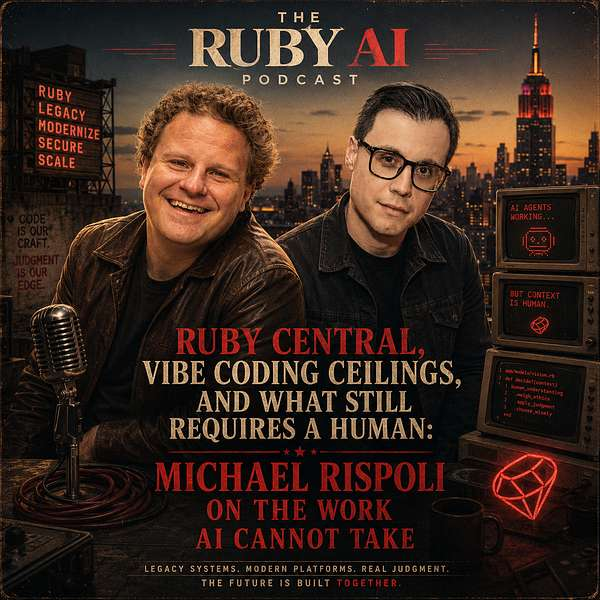
Ruby Central, Vibe Coding Ceilings, and What Still Requires a Human: Michael Rispoli on the Work AI Cannot Take
with Michael Rispoli
Listen to this episode
About Michael Rispoli
Michael Rispoli is the CTO and Co-founder of Cause of a Kind, a Rails modernization agency focused on high-security verticals including healthcare and education. He is known for building self-hosted AI tooling for Ruby applications and running the CTO Confidential YouTube series.
About This Episode
Mike Rispoli joins Joe for a wide-ranging conversation that starts with the state of Ruby's organizational infrastructure and ends with the limits of what AI can actually do.
They open with Ruby Central's financial situation — the leadership turnover, the end of the RailsConf gala, the formation of the Ruby Alliance and Gusto's decision to join — and debate what sustainable governance looks like for an open source community. Is the future corporate sponsorship? Fragmentation? Something else?
Then Mike explains how Cause of a Kind has repositioned around modernization for high-security verticals — healthcare, education, PE-driven remediation — and why they've deliberately avoided work that can be easily vibe coded. He describes the on-site 'War Room' offering, continuous security testing as a product, and his 'Behind Enemy Lines' series for training engineers in forward-deployed skills.
The conversation closes on AI workflows: Mike's multi-model setup (Claude, Kimi, Qwen, Codex/GPT 5.5), anti-patterns in AI-built products, and where the ceiling is for agents operating without human judgment.
Full Transcript
Valentino Stoll (00:01.413)
Hey everybody, welcome to the Ruby AI podcast. I'm your host, Joe Leo. My co-host Valentino is out today. He said he has something to do at Gusto and he didn't say what it was. I suspect they handed him a shovel and they told him to start digging for more money for Ruby Central. But I am excited to be joined here by another grizzled veteran of the Ruby world, co-founder, CTO of Cause of a Kind, Mike Rispoli. Mike, welcome to the show.

Mike Rispoli (00:29.612)
Happy to be here. Thanks for having me.

Valentino Stoll (00:31.886)
Yeah, thanks for coming on. I wanted to start here at the top of the show because this is, we're recording on May 13th and a post here from May 11th from the Ruby, from Ruby Central. Gusto joins the Ruby Alliance, quoting, the Ruby Alliance is a small coalition of companies that are choosing to make a significant investment in the long-term health, resilience and sustainability of the Ruby ecosystem and the infrastructure it depends on.

We are honored and humbled by how quickly and decisively Gusto moved to join us. They didn't wait to see what other companies would step forward. They recognize the importance of this moment and chose to lead the way. Interesting choice of words. They didn't wait to see what other companies would step forward. know, the Ruby Alliance was announced about a month ago, so I think what they meant was nobody else stepped forward. We're really awfully glad that Gusto did, because they're a big name and they've got lots of money.

Mike Rispoli (01:24.995)
You

Valentino Stoll (01:29.133)
This is after a series of breathless posts from Ruby Central in the last month, right? Executive director, Shan Curitin is out in less than a year. Truly unsurprising news there. We're out of money. We can't do the gala at RubyConf anymore. Sorry, David Black and everybody else who helped found RubyConf. And by the way, we're building a bunch of stuff like the Ruby Alliance, which isn't building anything, it's just getting more money. Project Dream, which is like,

somebody in that meeting was like, hey, we just gotta say something about AI, so let's do Dream. And then an apprenticeship program where they take a bunch of people from underrepresented groups and have them work, presumably for free, on a bunch of these initiatives. So my first question for you, Michael, is this the end of Ruby Central?

Mike Rispoli (02:17.208)
Man, is, this is like a tough, yeah, hit me with a hard one right away. Is this the end? You know what? I don't know. Look, if there is a conceivable that they could get like a bunch of corporate sponsorship, I kind of think that's the future for a lot of stuff. Now, it seems like, I don't know, maybe for most of my career, open source kind of ran through donations, a little bit less corporate sponsorship, but it feels like...

Valentino Stoll (02:20.835)
I

Valentino Stoll (02:33.261)
Hmm.

Mike Rispoli (02:45.346)
that may be the way that they need to go. And then, you know, then there's the whole, like, I mean, there was the whole debacle about Ruby gems, I want to say like last year and early, yeah, that was last year, right? And that was a whole thing. And it was kind of like, wait, what's going on here? so it's very, it's really interesting how you see these evolve because now like in the, on the other community I'm a part of is the JavaScript community. We just seem to like, well, we'll just build a new.

Valentino Stoll (02:55.597)
That was last year's controversy. Yeah, yeah, yeah.

Valentino Stoll (03:01.815)
Mm-hmm.

Valentino Stoll (03:14.293)
Yeah, right.

Mike Rispoli (03:14.378)
like, yeah, like we're just, yeah, I'm just gonna go do Deno and then I'm gonna build JSR, like forget it. Then we're like, we're just doing like a totally new thing and you keep reinventing stuff. So like one of the interesting things about Ruby, one of the valid things that I liked was that they didn't seem to spend a lot of time on reinventing stuff and there wasn't a lot of fracturing for a really long time and now it feels like there is.

Valentino Stoll (03:31.872)
Yeah.

Valentino Stoll (03:35.36)
Right.

Yeah, think that's probably, I think that's insightful, you know, because we're here on the heels of, you know, last ever RailsConf was last year. I am openly wondering if I'm about to attend the last ever RubyConf in July. And you know, I'm going, all of Dev Method's going, and we're excited about it. And I should state that I, you know, I love RubyConf and I love what Ruby Central has done over the years. But you're, you you're in this world as much as I am.

And you've seen things change. And I'm curious to know, is there room or is there an advantage to some sort of guiding light, governing body, whatever you might want to, stewards of the Ruby community, and what kind of form should that take in this world of artificial intelligence and

know, extremely fast development and all of this change.

Mike Rispoli (04:40.578)
Yeah, I think it kind of goes back to that. You I've thought about this too. Like, do you do the, you know, the benevolent dictator for life kind of method around everything? And, you know, that seems to have worked well for Python and it kind of worked, you know, it's worked for Linux too, right? It's, you know, as much as people have problems with Linus, ultimately we ended up in a good spot. I like that, I kind of like when there is sort of like a guiding...

Valentino Stoll (04:48.234)
Right.

Valentino Stoll (05:01.278)
Mm-hmm. Mm-hmm.

Mike Rispoli (05:08.098)
principle like that versus the committee base. The languages that I've been a part of that didn't do so well, Elm had this with Evan, but then he lost interest. So then you run into that, or it seems like he lost interest. The Elm community is probably going to scream at me right now and be like, no, we're still here. But it does seem like he did lose a bit of interest in continuing to develop Elm as a UI. you run that risk. I don't think Matt's is going to like,

Valentino Stoll (05:18.335)
Yeah.

Valentino Stoll (05:22.399)
Yeah.

Mike Rispoli (05:37.315)
lose interest in Ruby. don't think DHH is losing interest in REA. Like it doesn't feel like any of that is happening in the Ruby community. And there have been, you know, those efforts of like pushing certain individuals out and like for various reasons. I'm always like, but they've always done a good, I feel like the language itself has always ended up in a good place and the framework itself has always ended up in a good place. I worry if there's more committee or other corporate sponsorship, what ends up happening there.

Valentino Stoll (05:42.789)
Yeah, true.

Valentino Stoll (05:58.728)
Mm.

Mike Rispoli (06:07.084)
And it's going to be interesting to see. But like Golang has done well under Google stewardship, even though I feel like Google doesn't use it very much. From what I've been told by Google people is Golang isn't actually like a very big internal use for them, like as big as C and C++ and other things. But people love it. So they've done a good job with it.

Valentino Stoll (06:13.298)
It's true.

Valentino Stoll (06:23.079)
That's funny.

Valentino Stoll (06:31.312)
I think there's something we said for what you're putting out there. And I agree with you on the, there's like a thin line here between corporate sponsorship and corporate investment. know, mean, Augusto has, Shopify has, I'm sure several other companies have, departments that are focused on just working on Ruby and on just working on

Rails because it benefits them. They use the language so much that some gain in performance, some kind of efficiency, some kind of fixed to memory, is why you got these great compilers coming out of Shopify.

you know, it benefits their company. And so they put that investment in in a similar but different way. know, Google did that for a long time, right? They invested in the language because the language was benefiting them.

Beyond that, when you talk about sponsorship, then there has to be an organization that collects that sponsorship, those sponsorship dollars, and then there has to be a committee that decides what to do with those dollars. And so it does become a different thing. And for a long time, we got a lot of benefit out of Ruby Central. And that's not to say that we won't in years to come, but it's looking kind of shaky. And I'm just kind of openly curious what the future holds. I guess everybody is to a degree, and we'll learn more when we get to

Mike Rispoli (07:53.751)
Yeah.

Valentino Stoll (08:01.24)
to Vegas in a couple of months. Are you going? Are you going to RubyConf?

Mike Rispoli (08:05.529)
No, I was thinking of going to Railsworld, but I wasn't going to go to RubyConf this year. Yeah, because we had just gotten back from AI engineer Miami and I was like, oh, well, for us, have our families and stuff. So it's like hard to get away. But I was like, all right, maybe it'll be Railsworld because I'm kind of, I mean, admittedly, the Railsworld, they do a great job of social media. It always looks like fun. I'm like, it just like makes me want to be there. So I'm like, we got to go to that. It's going to be in the United States. I was like, flying to Amsterdam was not like possible for us last year.

Valentino Stoll (08:12.901)
Mm.

Valentino Stoll (08:17.678)
Right.

Valentino Stoll (08:27.525)
Yeah, yeah, that's right.

Mike Rispoli (08:34.894)
I was like, we got to go to that. didn't think about, you know, I didn't even really think about RubyConf to be honest. I mean, maybe that's that answers your question about what's at all with Ruby Central. I was like, I didn't really think about it, you know, like I was like, oh yeah, there's a conference they're putting on and it's there. So you didn't know. It feels very much like, I guess when I think of Ruby, it's like so synonymous with Rails and you talk about Shopify, DHH and like that whole.

Valentino Stoll (08:35.171)
Yeah, I get it.

Valentino Stoll (08:42.533)
It does say something.

Valentino Stoll (08:49.538)
Yeah.

Valentino Stoll (09:00.27)
Hmm.

Mike Rispoli (09:03.188)
that whole ecosystem. And it gives me lot of confidence in investing in it because I know that Shopify is doing well. They're at the forefront of AI. So I think about things like that too, when I'm choosing to continue to use Rails, especially kind of our return to Rails after years away, it was not an AI driven decision because AI would tell you to build everything in TypeScript and Python. It was really like, I was like, hey, I kind of have this hunch this is going to work better. And then

Valentino Stoll (09:13.41)
Yeah.

Valentino Stoll (09:27.147)
Yeah, yeah, right.

Mike Rispoli (09:32.68)
seeing, like we were at Omicon this year, so seeing Toby talk about Shopify's investment in AI and kind of the future there, I said, you know, I think the future's really bright for Ruby and Rails in particular, and we should be advocating for people to be on this platform. Now, all these governance issues, man, it's, I kind of like this idea, and this is maybe, you know, there's a piece of me that likes sort of a decentralization, so to speak.

Valentino Stoll (09:47.555)
Mm-hmm.

Valentino Stoll (10:01.313)
Mm-hmm.

Mike Rispoli (10:02.306)
but there's a part of me that's like, maybe it should just be like, you know, it should all be owned in one place. You that was how I felt even about the gems issue. was like, maybe this should live with the Ruby language. Like, this should live together. There shouldn't be this issue. There shouldn't be this takeover of people's past. Like, it shouldn't even be possible to do things like this. You know, it's interesting. Then again, now I'm a...

Valentino Stoll (10:11.5)
Right.

Valentino Stoll (10:15.736)
Right.

Valentino Stoll (10:24.651)
I say, yeah.

Mike Rispoli (10:29.612)
with the recent attacks on NPM. And I think Gems is going through that now also. I kind of come back to like, we should be doing the go-mount or what Ryan Dahl was advocating for Deno originally too, which is get repo URL. Those are your packages and like you own them and like get away from the centralized managers. I don't know what, you know, we're going to see what's going to start to happen as the surface area of all these things takes like gets the attack surface area gets bigger anyway.

Valentino Stoll (10:44.906)
Yeah, right, yeah.

Valentino Stoll (10:59.36)
Yeah, I agree with you and there's a lot to say about that as well, but I want to, the attack surfaces specifically, but I definitely want to turn now to two cause of a kind and especially because you've got some all new branding out there, right? New website, modernize your software. I went there looking for one thing and I saw another. So tell me about that. Tell me about the word modernize.

Mike Rispoli (11:14.868)
new website.

Mike Rispoli (11:23.47)
Yeah, yeah. I'll tell you, Justin and I, every year, we're always evaluating. As an agency, there's these ups and downs. And I tell people all the time, through last year, were riding high, signing tons of deals. We were doing amazing. And then January, we were still doing great. then we've kind of... February, March, April, there's been a bit of a lull, I want to say, in our...

our pipeline. And this happens every year. I'm prepared for it as an agency. But every time that sort of happens, I have to ask myself, this just normal or is there like something going on? And because it doesn't match the typical seasonal lull of our books, I said, think that there are shifts happening and things that we were previously offering

Valentino Stoll (12:09.12)
Mm-hmm.

Mike Rispoli (12:17.513)
are becoming less appealing. then we also kind of had to reevaluate our price points. I was very, you know, there are things, for example, landing pages, websites, we used to do a lot of this type of stuff, WordPress, even the Shopify theme market. I don't know if there's, with AI, if there's going to be much of a competitive place that we can sit in that space.

Valentino Stoll (12:34.259)
Mm-hmm.

Valentino Stoll (12:41.545)
Yeah.

Mike Rispoli (12:43.013)
And we sort of reevaluated and I said, well, what are some of the things that we've been doing that go really well? What are some of the verticals? It seems like healthcare tech is big because there's a security requirement there that means that they're not just going to have like the CFO vibe code, their accounting thing into existence. So we hope, we should hope, right? So it's like, great, we know healthcare. Education, we're getting contacted, like some of our best leads coming in now.

Valentino Stoll (13:00.103)
We hope, yes.

Mike Rispoli (13:09.613)
Education tech is big. People are looking to do big migrations of things to new platforms. And AI is there. It helps me do things like that, but the people, they don't know how to do it and they don't know, we're talking huge databases. So I was like, okay, these are good places to go. And then the other thing that started to happen was these modernization initiatives. We had been working with a couple of PE funds and were contacted by another partner of ours that says, get these things,

Valentino Stoll (13:21.223)
Yeah.

Mike Rispoli (13:38.518)
all the time, which is basically a company wants to get acquired, they do like a tech audit, and there's problems, and they want that remediated before any kind of purchase happens. And I look at that as another big spot where you're not just going to vibe the remediation into existence. And that started with this idea. Now, this product, we added a third product of really top tier offering called War Room, which ...

Valentino Stoll (13:43.41)
Yep. Yep.

Valentino Stoll (13:55.41)
Mm-hmm.

Mike Rispoli (14:03.949)
We have two levels of subscriptions that we've always offered, kind of like this half work stream and a continuous work stream. Added War Room, which is on-site specifically, like we're going to come in and it was a top tier offering. We talked about it, I want to say a year and a half ago before ever putting it on the website where I said, we should figure out. I just had this hunch that this was going to be the thing. It's sort of like Forward Deployed Engineering as a service because we had a number of clients where I felt like if we had gone on-site, things would have even gone smoother.

Valentino Stoll (14:13.259)
Okay.

Valentino Stoll (14:27.549)
Mm-hmm.

Mike Rispoli (14:33.715)
not for a long period of time, but like trying to get this engineer in a meeting was impossible, trying to get security, figure out where things were. And I was like, man, if we were just in the building, we could have said, okay, we're going to be in the building this week. Everyone's got to be here. We got to get all this figured out because we run into these like .NET code bases that have lots of legacy software, things that people don't know what's going on. There's sometimes a hodgepodge of different languages. Someone built this thing once upon a time, that thing.

So we were looking at that in the mid-tier kind of enterprises and we said, hey, we should go after this type of stuff. And then just AI enablement in general, one of the other pieces in building agents for people was I felt like I needed to go and watch people work sometimes. Like I couldn't automate what I didn't understand. And I think that was something I keep seeing on Twitter. And I was like, this doesn't actually work where you're just like, I'm going to go in and put in like

Valentino Stoll (15:23.002)
Yeah.

Mike Rispoli (15:32.654)
automated answering service and all of your problems are going to go away. And I was like, I would love to see someone try and sell that to a small business owner. And I already know what they would tell you here on Long Island. And so it was just, I was like, let's revamp this. Let's talk about modernization, upgrades, because this is where I think the puck is going and where we're now getting, like I want to say in the last month,

Valentino Stoll (15:35.034)
Yeah.

Valentino Stoll (15:46.446)
Yeah, right.

Mike Rispoli (15:59.212)
This is where all the lead volume is coming from, is this modernization. We have migrations, modernizations happening, new apps we want to build or old apps we want to upgrade. So I don't know if that's a long-term trend, but I feel like it is, and I just want to get away from what could be vibe coded.

Valentino Stoll (16:17.531)
Yeah, I think that that last statement, you know, trying to get away from what could be vibe coded, that's what lot of people are, people of, you know, of your and my ilk are trying to do, right? Because there's so much that can be automated, which is good. You we use the tools, you use the tools. We can get our agents to write a bunch of code and then we can be responsible about it and make sure the code works.

But we're going to move really quick on that. And there is a lot of downward pressure on anything that can be built without too much human intervention. Right? And so what I hear you saying, and you can correct me if I'm wrong, is, let's look for the places where the humans really got to be there. Like you really have to have somebody who knows what they're doing, even with the tools, or else something could go wrong. Right? So they could break.

You could have a security violation. You could have a bunch of patient information let loose into the public, right, or something like that.

Mike Rispoli (17:27.905)
Yeah, exactly. That's what I'm thinking because risk is the thing people are willing to pay to mitigate. That's kind of a... We pay for insurance for this reason. Nobody would have insurance if we only needed to worry... Dude, it's been brutal. This is one of the things I tell people. go for...

Valentino Stoll (17:35.309)
Mm-hmm.

Valentino Stoll (17:42.488)
God my renewals are coming up. You just reminded me. Yeah

Mike Rispoli (17:50.35)
One of the hardest things about being a small business owner is health insurance. We could do like a whole episode on that because I'm like, for a place that likes entrepreneurs, they really don't like entrepreneurs in this. But yeah, this is kind of what I've been racking my brain around. And now we talked about this on our podcast, whereas we were always after the short sales cycle type stuff, we're starting to go after longer sales cycle type stuff because we're realizing that

Valentino Stoll (17:54.584)
Ech.

Valentino Stoll (17:59.412)
Yeah, yeah, yeah, I know.

Valentino Stoll (18:16.564)
Interesting.

Mike Rispoli (18:19.565)
the short sales cycles type stuff, a lot of folks are like, oh, we're gonna try and do it ourselves first. And I actually think that stuff is gonna come back around. And if you look at kind of where I'm positioning our podcast and some of our other marketing material is I actually wanna teach you to do it yourself as far as you can get it. And then I want everybody who gets stuck, which will probably be like, if a hundred people do it, they'll probably be like 40 % that gets stuck or something. this is like...

Valentino Stoll (18:40.736)
Right.

Mike Rispoli (18:47.915)
the goal of trying to build this lead funnel of let's teach everybody to do everything they can with AI. Like let's blow the lid off this thing. But what remains is going to be really hard work. And that's kind of where I want to sit. And then it goes back to hiring engineers. If you take low value work, it's very hard to keep people employed. The stuff turns around too fast. Like a landing page takes me a couple of days to stand up. can never hire someone around a landing page pipeline unless

Valentino Stoll (18:56.363)
Mm-hmm.

Mike Rispoli (19:16.671)
Hundreds of people are bringing their landing pages to me. I can't do it

Valentino Stoll (19:17.758)
Yeah, right. Yeah, yeah, no, that makes a lot of sense. I, you know, we went through this, know Cause of a Kind is, how long have you guys been in business?

Mike Rispoli (19:29.407)
We've been in business nine years, but since we left our jobs, it's been four. So that's why I always say, yeah.

Valentino Stoll (19:34.134)
It's been four years, okay. Yeah, so that's a big cut over. I had an advisor when I was first starting out with DeafBetht. And I was working full time and I had DeafBetht or whatever I was calling it at the time on the side. And he was just like, you're never gonna make it. It's never gonna succeed until you depend on it for dinner. And he was right about that. So okay, so four years and congratulations on that. Nine years in general. What I've noticed is that,

Mike Rispoli (19:54.06)
That's true.

Valentino Stoll (20:03.379)
You know, things have changed a lot in the entrepreneurial space in that, in that time, certainly over the last four years, because what used to happen is that people would try to build things. Scrappy is a generous term for it. Really it's, poorly, just make it work for one path through the code. Right. And the idea was that's going to cost a lot of money even doing that.

It's gonna cost you 150, $200,000 and if you want it done anyway right and then you have to go out and you have to raise money so that you can build more and it's always like well we'll fix it later, we'll fix it later.

Which of course never happens and that's when you inevitably would, you you would call death method because you would eventually get yourself in a place where you were kind of screwed. and we love, and we love that work, but now you don't have to do that. It's still an option. There's always an option to do it poorly, but you know, we just, and we hardly, we don't usually go after, bootstrapped startups anymore for, for that reason. Cause the turnaround is, is so quick.

Mike Rispoli (20:58.03)
Yes

Valentino Stoll (21:12.573)
The amount of education that you have to, the amount of time you have to spend sort of educating the entrepreneur who has never done this before is intense. And so my time would get sucked into into it. But now like I've had this recent experience where, Hey, we can get something off the ground in a couple of weeks. You know, we used, I used to tell people, know, we're not going to ship anything that you're going to want to show anybody for like three months. And now, you know, a couple of weeks, you can get something out there. And so now you can build it really quickly and you can build it well.

Mike Rispoli (21:38.882)
It's true.

Valentino Stoll (21:41.579)
And so you're not forced to make that horrible choice of like, have to spend a lot of money or wait six months just so that I can get something that is well constructed.

Mike Rispoli (21:53.78)
Exactly right. And we get a lot more people doing like the lovable thing first. again, we get a lot of... I have one right now where they built it in lovable. They validated it internally, but they were like, we definitely can't use this prototype. Like things don't work. We don't want to be hitched to lovable's wagon. This is a big enterprise. But it allowed them to put it in front of a team, figure it all out. Now there's a person working on kind of the classical design with Figma came to me.

Valentino Stoll (21:59.282)
Yep.

Valentino Stoll (22:06.33)
Mm-hmm. Right.

Mike Rispoli (22:23.659)
and I basically take them both and I just go with Codex. with it, so it's so funny. It's clear that they haven't worked a ton with an AI driven engineer. They gave both to me. They outlined the first sprint. I was like, okay. was like, I'm like sitting here like, it was like one of those moments where I was like, easy, like definitely gonna be able to, but like almost got the whole product done in two weeks and like very, very close. then, and,

Valentino Stoll (22:44.229)
Yeah.

Mike Rispoli (22:50.677)
just rebuilt totally on Rails like I did like a Rails, you know, rebuild. And I was like, listen, we don't need to worry about reusing any of that code. I'm glad you have it. I'm glad it's here. I'm glad you can pull specs out of lovable because that's what helps Codex. Still a million decisions to make in between though. Like as I'm going through it, I'm like, well, you have, you have duplication here and there's, there's all sorts of stuff that we still talk about, but the speed of it is incredible. And so now,

Valentino Stoll (22:52.646)
Yep.

Valentino Stoll (23:01.67)
Mm-hmm.

Valentino Stoll (23:07.611)
Sure.

Mike Rispoli (23:16.757)
What's happening is that same venture goes, we had this other project that we thought we were going to do after, but now we want to just like, we wanted to keep going because there's all this software that we've been using SaaS for, or we always wished we had, and now we can afford to just do it at this pace. So I'm like, great, but this is through a startup that is still building a SaaS, but...

Valentino Stoll (23:23.129)
Yeah. Yeah.

Mike Rispoli (23:40.782)
It's in the film industry. So once again, very secure. They're very, very worried about especially like the creative getting stolen and things of that nature. They're all asking for like bespoke custom deployments. And so what was supposed to be the vision of a SaaS company, venture funded, is sort of turning into a maybe we do custom deployments of this and we sell licenses of this stuff. And it's really...

Valentino Stoll (23:43.779)
Yeah.

Valentino Stoll (23:48.643)
Yeah.

Valentino Stoll (24:04.055)
Interesting, yeah.

Mike Rispoli (24:08.661)
It's so easy to do bespoke now because I just am like, okay, we're going to take exactly this thing and we're going to make it this way with these three editions. the AI makes that really, really possible in a way that just wasn't before. And so I'm like, this is a whole new business model because the former business model was always, we want to make multi-tenant SaaS. And now it's like, well, we'll do an on-prem deployment. That's the idea behind War Room too. I'm like...

Valentino Stoll (24:16.164)
Yeah.

Valentino Stoll (24:33.975)
Yeah.

Mike Rispoli (24:35.425)
listen, you pay for it, I'm flying in. No problem, I guess. But this is what people are wanting. They're like, do we do an on-prem? Do we do a backup? Something like this, because the security, again, going after these high security areas is definitely peaking my interest, because it seems like this is gonna be a very big thing. And there's a new security problem every week.

Valentino Stoll (24:37.43)
Right, yeah, yeah. Yeah.

Valentino Stoll (24:51.01)
Yeah.

Valentino Stoll (24:59.446)
Well, yeah, and you had mentioned this at the top of the show and it's something I've been writing a lot about lately, which is that some of these security issues that have been happening, know, famously one with GitHub, one with Forsell a couple of weeks before that, you know, they are, it's like, it's the greatest time to be a nefarious actor in the world.

Right? It's also the greatest time to be like a security engineer because there is so much, right? There's just so much. And one thing that I had hit on that I'd like to get your reaction to is it seems to me like just being able to detect your security flaws is really not enough anymore, right? We need something where we are actively and continuously resolving security flaws.

Because look, I've been detecting security flaws for my whole career. And when I see them, like, all right, I fire up Docker. Docker gives me a whole bunch of CVEs that exist on my machine. I get to them when I get to them in order of severity. And I don't worry about it too much. Well, there was never an ever-evolving, continuously built

Mike Rispoli (26:18.391)
Yeah.

Valentino Stoll (26:20.98)
like mega monster of an AI searching for every security flaw to expose. And now there is, or at least there can be.

Mike Rispoli (26:27.839)
Yeah, well, that's it's definitely it feels like someone put the Ralph loop on and just said just keep trying to break into these services and just like don't stop and don't stop. this is so there's like two prongs. One is like the penetration testing, which.

Valentino Stoll (26:33.067)
Yeah, just keep trying. Yeah, have you broken it yet? Yeah, yeah.

Mike Rispoli (26:44.829)
I had been through them, but I never learned to do it myself. And now suddenly I was like, I'm kind of interested in this, very Mr. Robot. I'm like, okay. And again, AI is providing a lot more time in my schedule to learn some of this stuff that I would have previously not had time to do. And then the others, so we want to offer that. And then I think about that too, continuously trying to penetrate your own stuff.

Valentino Stoll (26:49.685)
Mm-hmm.

Yeah.

Mike Rispoli (27:10.655)
all the time, like as a regular, part of, not just a SNCC or something that runs statically, but an actual like fire up the headless browser and like somebody tries to break in once a month kind of part of like an ongoing service.

Valentino Stoll (27:16.213)
Mm-hmm.

Valentino Stoll (27:20.777)
Yeah, this is the chaos monkey, like Netflix is chaos monkey, but for security. Yeah, I totally agree with you. Yeah.

Mike Rispoli (27:25.821)
Exactly. And you just kind of attack it. this is where, now at some point, as all things, think that's going to be huge, but I also think we're going to resolve a lot of these. Like I think this continuous attack is going to make all the software more resilient. And at some point, you'll hit a place where we were maybe a year ago, where it felt like everything was pretty secure. And if there was a zero day bug, wasn't very common. There's going to be like an uptick in this, and then we're going to

gradually get over that hump, but I think that we have a long way to go because the other thing that opens your surface area was you talked about the Versel attack. I was suddenly worried because I go, all right, yes, I'm built on Next.js, but I'm also on Versel. Had I not been on Versel, I could have patched it and been like, well, no one was coming after that tiny little app or whatever. But now that you're on Versel, it's like, well, they stole everybody's stuff. And so now I'm like, man, you look at Versel, you look at Cloudflare, you look at AWS, and I'm like,

Valentino Stoll (28:13.524)
Yeah.

Valentino Stoll (28:18.644)
Yeah.

Mike Rispoli (28:23.115)
should I be going with like a smaller, at least a smaller cloud provider? You know, I've been looking at like, yeah, yeah. And again, that's not true security, but at least it gives you time where it's like, they stole all of Versel stuff. And you're like, great, I built it. You know, I'm going to go patch everything up on my side because I wasn't a part of that. You're definitely, now there's some aspect of, in the agency world is,

Valentino Stoll (28:28.081)
Right, security by obscurity, yeah, yeah, yeah.

Valentino Stoll (28:39.486)
Yeah.

Mike Rispoli (28:50.285)
You don't get fired for choosing IBM. You don't get fired for choosing Vercell kind of situation where it's like, well, all of Vercell got stolen, so your stuff got stolen by default. Don't worry. You're in the same boat as most of your competitors. And so sometimes there's a comfort in that. When AWS is down, everyone goes, cool. AWS is down. Don't worry. But if my bespoke under my desk thing was down, you'd be like, Mike's a moron. So you've got to balance those two things.

Valentino Stoll (28:53.001)
Yeah.

Valentino Stoll (29:00.585)
Yeah.

Valentino Stoll (29:09.946)
Yeah. Yeah, it's all your fault. I know. I know it's true. It's true. Let's talk about the tools for a minute because I was really interested in this. This, cause you, think Mike, you had this right. You've been talking for a long time about, at least since last year about not just relying on one model, not just relying on one.

kind of piece of software, one harness because, kind of extolling the virtues of open source, whether that's in the models, whether that's in the hosting, right? I know you did at one point do a lot of self-hosting on your own framework desktop. I don't know if that's true anymore. I'll be interested to hear about it. So the thing that I thought, and I...

I never disagreed with you, but I was always like, okay, well that's interesting, but you know, there's maybe there's no urgency behind it. Well then Opus four seven comes out a few weeks ago. And then all of a sudden people were started paying 10 times the amount that they were paying for their token usage because they just absolutely had to have Claude codes latest and greatest. And when you get past the, the marketing and whether you believe it or not about how wonderful and how great Opus four seven is, you realize,

No matter how great it is, all the other models are going to be just as great in probably two weeks to six weeks, except there were a whole bunch of people that were not prepared for that and just ended up either spending tons of money or grinding to a halt on their development. I would imagine that does not, that statement does not describe you because you were kind of well diversified. So tell me a little bit about.

Mike Rispoli (30:49.6)
Yeah, yeah. So I had kind of felt the degradation of Claude code in Opus 46 for some time and it was myself and a number of our other engineers were complaining about it. And so I immediately was like, well, not a problem. got a llama. I'm going to go try. Like every time something like this happens, I go and like, let me fire up and see what the open source world is doing. I got, I tried Gemini 4 or the Gemma 4. That was it. That wasn't too...

I wasn't happy with that performance at all, and it was slow, and it wasn't very good at coding. Quencoder was pretty good, and that I was able to run locally. But again, you run into some of the speed issues. And then I tried Kimi 2.5, which was something that DHH had mentioned on a post, and I said, let me go with Olamma, try that. That I couldn't run locally. I don't have enough RAM for it. But on Olamma Cloud for like 20 bucks or something like that.

Valentino Stoll (31:30.917)
You

Mike Rispoli (31:43.023)
That was actually good. So suddenly I was like, oh, well, I don't really need Opus. Like I could get by with this. And I go back to it requires me to use a little bit more of my engineering skills, which I kind of like anyway, because it doesn't do as much of the thinking for you. I was like, I don't need, I'm not going to pay you a thousand dollars a month for like this. You know what I mean? I'm just going to do a little more work on my side and that's fine. And then, then of course, GPT 5.5 comes out. was using, I was using open code.

Valentino Stoll (31:47.961)
Yeah.

Valentino Stoll (31:56.024)
Yeah. They're not atrophying, Right.

Valentino Stoll (32:06.754)
Yeah.

Mike Rispoli (32:12.962)
But then I was like, let me try Codex. And that's been the thing that I've been using. So I was like, this is great. So it's so funny because then they did that whole mythos stunt, you know, with the whole thing. Yeah, I was like, this one's too good for you. Like you can't touch the... Yeah. I was like, okay. Like I was like, and so I was like, okay, fine. I guess I'm not worthy.

Valentino Stoll (32:14.542)
Mm-hmm.

Valentino Stoll (32:22.924)
Yeah, the mythos thing. Yeah. Yeah. Yeah, I know.

Valentino Stoll (32:34.084)
I know, yeah exactly.

Mike Rispoli (32:35.382)
I was like, I'll take my money elsewhere. I took it right to OpenAI and Ola Hama. And that was it. And I found that, so like right now I'm enjoying Codex and GPT-55 and I do switch to Kimi just like every now and then, but I actually find GPT-5.5 on low thinking is getting like the best performance for me right now. And I was really surprised. just, again,

Valentino Stoll (32:50.168)
Mm-hmm.

Valentino Stoll (32:59.032)
That's interesting.

Mike Rispoli (33:03.446)
one of these things where you kind of have to be in the bubble watching this stuff, someone had mentioned it. I said, let me try that. And it was funny, because I had this situation that I want to say it was maybe like a Monday, Monday night, I switched to GPT-55. It does a solution and it created in this Rails code base, it built a bunch of these service modules around this one feature. And it kept me up because I didn't want to commit it. just like didn't, I was like, this is not the way I would do it, but it worked. So I was like, kind of went through and it was working and I was like, do I?

Valentino Stoll (33:29.42)
Yeah.

Mike Rispoli (33:33.231)
Do I go back? And I go to bed, I woke up the next day, I said, I can't let it go, right? I was like, listen, I want you to do it this way. And so it made all my corrections. I was like, this should be like three functions, not modules. I was like, this should be like this. This is how I would do it. It fixes it. But then I switch it to low thinking, and it actually got it the way I would have wanted it in that mode. So I was like, ooh, I'm using this model a little wrong because in...

Valentino Stoll (33:37.686)
Yeah

Valentino Stoll (33:45.825)
Yeah.

Valentino Stoll (33:57.378)
That's interesting.

Mike Rispoli (34:00.011)
In the Claude world, everybody's on high or extra high. But with GPT, everybody's like, go low with the thinking. And this is where I say you have to try the different models because they all behave differently. They're all good at different things. And I think this is going to be a future. Like I'm really excited if Quencoder, if I could run Quencoder locally and get very similar performance because I don't need...

Valentino Stoll (34:04.255)
Yes.

Mm-hmm.

Valentino Stoll (34:23.298)
Mm-hmm.

Mike Rispoli (34:25.196)
like the history of the world in my model. I just needed to know. I can't wait till we get the Ruby on Rails and React only model. That kind of thing where you can actually say, you can run this locally so if the clouds are down and everything's out, you're still kind of working with something. It's open source so you own it. But it's very clear from the business owner's perspective that we're very dependent on this because everybody was like...

Valentino Stoll (34:28.767)
Yeah.

Valentino Stoll (34:34.868)
Yeah.

Valentino Stoll (34:45.077)
Mm-hmm.

Mike Rispoli (34:51.476)
One thing I don't want to do is go back to hand typing the code. I absolutely don't want to do that. So it's very clear that this is the future for writing code, and we were able to get by when things are down, but it was really nice to say, like, hey, some of the open source stuff is getting there. It's getting close anyway.

Valentino Stoll (34:54.419)
Yeah.

Valentino Stoll (35:10.568)
Now, when you're switching between models, what is it like? Is it a big lift? Like, how are you switching?

Mike Rispoli (35:17.07)
It's not a huge huge lift like with olama. It's pretty and and open code. It's pretty easy You can just change it right in the tool. Yeah, I've been thinking about trying pie dev, too That's the other one that I have not gotten a chance to try but someone recommended to me If you go with like the harness like codecs, it's a little different, know, that's you know You I think you can also switch there but most of the time I just go to open code and I'll run olama and I'll

Valentino Stoll (35:23.391)
With open code,

Valentino Stoll (35:32.852)
Hmm.

Mike Rispoli (35:44.289)
and I'll run with the model I'm running locally or I'll run with a Cloud Olamma model. And that's been kind of my flow to test these things out. And yeah, it's worth having the subscription to it because sometimes I'm like, I'm just going to use Kimi for a day. Kimi asks you a lot more questions. So it definitely, it reads between the lines less, which can be a good thing, but it'll ask you like quite a few questions. You don't need to use that skill that some people use where it's like interrogate me until I'm tired.

Valentino Stoll (36:02.063)
yeah.

Mm-hmm.

Valentino Stoll (36:14.27)
Yeah, yeah. So you just touched on this a second ago, but is there, is there a threshold or is there some, is there some tasks where you're just like, okay, I'm not, I'm not reaching for an LLM right now. I've got, there's something that just needs to be done. need to either figure this out or I need to, or I'm going to type this out or I'm going to test this out. Are there things where you're just like, I'm going it alone.

Mike Rispoli (36:14.51)
Kimmy will interrogate you till you're tired. I found that.

Mike Rispoli (36:44.716)
That, unless I'm intentionally doing it, so I do intentionally try to code a little bit each day or at least every week because I don't want to lose kind of the skill. What I will say happened, it happened with Codex when it created that PR with too many modules. I knew there was something wrong, but I want to say that I was working on two or three different things. I was in some meetings. I wasn't in the head space to think about it.

Valentino Stoll (36:57.084)
Mm-hmm.

Valentino Stoll (37:03.72)
Yeah.

Mike Rispoli (37:14.136)
there was a big part of me that said, just want to throw this thing over the fence and just, you know, I tested it, it works. I actually had to like go on a walk and think, okay, forget that Codex did anything. You're in Ruby on Rails, you're sitting in front of your ID, how would you have done it? And so it took like completely clearing my head and like not being polluted with what it had done. And I said, I would have done this. It would have been three functions called this. I went back to Codex and said, hey, this is what I would do.

Valentino Stoll (37:17.296)
Yeah.

Valentino Stoll (37:28.87)
Mm-hmm.

Mike Rispoli (37:40.92)
and I let it write the code and it did it. So I didn't like go back to hand typing it myself, but I did have to take that time and say, I'm going to go on a walk and just forget everything that was done because I need to get back into the thinking mode. I think it is easy to get get lulled into this like, you know, you got all these things, everything's going smoothly. And then you hit one where you're the pull request just has a very clear code smell. And you're like, I wouldn't, I can't let this go.

Valentino Stoll (37:42.797)
Mm-hmm.

Valentino Stoll (37:59.953)
Yeah.

Valentino Stoll (38:06.374)
Yeah.

Mike Rispoli (38:09.815)
I find I have to step away to bring my brain back to focus mode on that one problem.

Valentino Stoll (38:15.184)
I like that solution quite a bit. That stepping away has helped me many, many times in the past. I that's why the Pomodoro was invented, right? was so that we could step away at frequent intervals and let the background processors in our brains operate.

Mike Rispoli (38:31.455)
Exactly, exactly. takes a minute because it's especially true now because you get so stuck in that agent loop and they perform so well for so many tasks that when you finally hit a task that you can't... I think even our website redesign was a good example of that where I knew what I wanted, but I didn't know how to describe it to the LLM the right way. I had to really kind of...

Valentino Stoll (38:48.985)
Mm-hmm.

Mike Rispoli (38:57.775)
think it out, draw it out, and then work with it to see what was going to work, what wasn't going to work. that was, again, I still use the LLM for writing a lot of the code, but I did know, like I will feed it, like this is what the CSS should be, this is how you should be structuring the HTML, because I knew that it would kind of not get what I wanted, and it would do something weird.

Valentino Stoll (39:13.37)
Mm-hmm.

Valentino Stoll (39:17.89)
Yeah. Well, so on that topic, I'm interested in this because you've, I think you, you've had a lot of experience in this. You're coming in at a point where a lot of people have tried to vibe code something or they've tried to build something on their own with AI and they have, they've either failed or they've run up against some, they've come up against a real blocker. And I'm curious to know if there are some,

anti-patterns that you see or there's some common things that you're like, well, yeah, this is where you went off the rails. A lot of people go off the rails here. Is there anything that kind of stands out to you?

Mike Rispoli (39:51.844)
Yeah, I think it's, for me, it's mainly, aside from the tech stacks all being picked exactly the same, that's that's the kind, it's just like SuperBase, Next.js, Versel, Resend, like there's a classic stack that gets picked no matter what. And so sometimes people, and I'll get these PRDs where they try and, they reason their way into using that stack. this is, and I'm like, you know, there's like a way simpler way to do that than this. So there's the overcomplexity, but

Valentino Stoll (39:59.674)
You

Yeah.

Valentino Stoll (40:16.213)
You

Mike Rispoli (40:21.825)
It's because the LLM or the Vibe tool is centered around this one way of doing things. really doesn't know how, it can't step into a different ecosystem. So you get stuck with that. But the other piece of it is building way too much. Like every single thought that, you know, it'd be nice, you know, it'd be nice, you know, it'd be nice. And suddenly you end up with these really crazy dashboards. They look beautiful. And...

Valentino Stoll (40:40.833)
Yeah.

Valentino Stoll (40:46.922)
Mm-hmm.

Mike Rispoli (40:48.097)
It reminds me of like what Dribbble was back in the day for design where it's just like amazing and you're like, this is amazing, completely impossible. But really, really cool. It would be all this stuff and I go, where are you getting all this data from? How does that, you'd point to like one little chart and they're like, how does that work? And they're like, well, it's gonna do this thing, but I haven't really figured that part out. And so they build all this, they overbuild all this stuff and then they kind of want your help making it real. But really what I need to help with is,

Valentino Stoll (40:50.796)
Ha! Tribble, yeah, I remember. Yeah, yeah.

Yeah. Yeah.

Mike Rispoli (41:17.207)
I need to rein this thing in into a much, much smaller product because the other thing that people forget is marketing is so freaking hard and it's truly the hardest thing. And if you build a very complicated product, how are you going to market that? What feature are you going to show people that you have to have a way for people to enter? And if there's like seven different potential entry points, how are you going to begin to carve out a place in the marketing world

Valentino Stoll (41:18.796)
Yeah.

Valentino Stoll (41:32.023)
Right.

Valentino Stoll (41:41.356)
Mm-hmm.

Mike Rispoli (41:47.162)
You know, how will you build social, podcast, all of the landing page. You know, have one hero section to capture everybody's attention. Your product does 20 different things. What's the thing that's gonna bring people in? So people sort of forget and they think that the beauty of the lovable, of their vision is going to make its way out into the world. And I think you're seeing this a lot is just overbuilding. And so I really try to take into account.

Valentino Stoll (41:50.411)
Yeah.

Valentino Stoll (41:54.601)
Yeah.

Mike Rispoli (42:12.461)
And I think this is the future for agencies too, is you really can't just be a dev shop anymore. You really need to think about, of all the things you want, this is a really cool end goal when we get to like the Salesforce level. But where do we start? What's the one thing that we're gonna build that gets people into the platform that you can actually market? And when people look at it, they go, I need that. Versus, I don't know if this does, like if you go to, I tell people, go to things like ClickUp, you know, which has a,

Valentino Stoll (42:17.428)
Mm-hmm.

Mike Rispoli (42:41.967)
It does everything. And so some people, that's very appealing. They're like one stop shop. But I was like, try to market that. Oh, we do everything. I was like, that's a very hard stance to take. And those products typically didn't start with doing everything. They captured their market in something, in doing one thing well and moving forward from that. So I think that from a messaging perspective, these people give themselves incredible challenges when their products are that big also.

Valentino Stoll (42:50.166)
Mm-hmm.

Valentino Stoll (43:10.355)
I think you're 100 % right about all of this. It strikes me that you are uniquely positioned to talk about this because you do spend so much time, way more than most, in our industry, focused on the marketing piece for cause of a kind, right? Like how are you positioning yourself?

What do your business models look like? What do your products look like? And I see it. I see it with the week to week and the disco discovery, Or the disco, what is that, disco?

Mike Rispoli (43:41.893)
Yeah, did. just go, I'll tell you, week to week, we don't even really sell anymore, but that was our week to week and month to month. That was a product that, so that's the other thing you learn is there are products that do well for a period of time. Like we were selling week to week like crazy three years ago. We were like, this is going to be the thing. And then just like that, no more week to weeks. Couldn't sell them.

Valentino Stoll (43:48.777)
Right.

Valentino Stoll (43:57.415)
Yeah. Yeah.

Valentino Stoll (44:03.142)
my god, yeah I know. Yeah.

Mike Rispoli (44:03.952)
Couldn't get anyone to buy it anymore. And honestly, I was exhausted. You do a year of week to weeks. It was like building a new, it was like building 52 products in a year. Like it was, I don't know what we were thinking sometimes, but I was like, man, this is exhausting. Cause I may be the only person in the company that can actually execute on the week to week, which was designed and developed like every time. Couldn't take a day off.

Valentino Stoll (44:09.106)
You

Yeah.

Hahaha.

Valentino Stoll (44:20.338)
Right, so you're just needed every time, yeah. Yeah, well that's, that actually, that dovetails nicely, it brings me to my next point, which is that, so you know all this, how do you teach it? You've got other developers that are not going to be so well versed to go in and say, okay great, customer X, glad that you built this vibe coded thing, it does 10 different things, but that's not gonna sell, and it's gonna actually be, it's gonna really make your life hard when you try to productize these things that are right now just in sort of demo mode.

Mike Rispoli (44:49.228)
Yeah. So this dovetails nicely into a yet a new series that I'm working on, which is on forward deployed engineering, specifically training, because I think this is the piece that's missing. We have about three engineers now that actually one of them used to be an FDE with me a number of years ago. We were probably maybe the second company after Palantir to have forward deployed engineering. This is going back like eight years, maybe 10. It's actually 10 years now because they just

Valentino Stoll (45:13.915)
Yeah.

Mike Rispoli (45:18.586)
Company just got acquired, so it was like 10 years ago at this point. We were forward deployed engineers. I was like, let me take all the lessons. Most of the lessons of that job also came from completely outside of software. And I'm realizing that a ton of engineers don't have any work experience outside of software. So there's these weird situations when you work with a customer, non-technical or technical, that come up. So I've been doing this series where I tell...

Valentino Stoll (45:37.232)
Right.

Mike Rispoli (45:45.741)
a story from like working at Rent-A-Car or going rock climbing that pairs with this other situation that happened in software that something like the developer hates me and I don't know how and they're like they're resisting everything I want to do. Things that are very real about forward deployed engineering that you don't deal with if you were always a product engineer at a SaaS company. And that's the piece I have to teach. And I don't think everybody's going to like it because it's the job itself, I mean, because it's definitely

Valentino Stoll (45:49.231)
Mm-hmm.

Valentino Stoll (45:55.963)
Yeah.

Valentino Stoll (46:05.765)
Mm-hmm.

Mike Rispoli (46:16.26)
You definitely were the series I'm calling behind enemy lines because you definitely feel like you step into hostile territory a lot. And it can be on both sides, whether it's the engineering team or it's upper management, or you have to deploy something because they want to start getting an ROI on it. And you're the guy who's supposed to be integrating this. All of these things are require all these weird soft skills. And then there's the upsells too. Like a lot of engineers miss those opportunities when I was a forward deployed engineer.

you had to kind of look for these upsell opportunities too, where you were like, actually, you know what? There's another product we have that might suit this use case, but you can't lose your credibility. That's the trickiness. Like a salesperson can blow their credibility sometimes, but as the FDE, you have to be able to gently talk about a potential upsell, but also not lose your kind of impartiality and credibility. How do you tow that line? So I keep thinking about this. And so I've been recording these like 10 minute episodes.

Valentino Stoll (46:57.315)
Yeah.

Valentino Stoll (47:11.62)
Mm-hmm.

Mike Rispoli (47:16.456)
on these little pieces of forward deployed engineering, mainly to release, but also to train my team, because I think this is gonna be something we have to really gear up for, because I can't be the linchpin of like all of the product, how do you do product and design and sales and marketing? How do you take all these things into account? And it really is having a business sense, and some of it is running a business, we'll teach you this. And some of it is just, if you don't have it,

Valentino Stoll (47:26.941)
I see. Okay.

Mike Rispoli (47:45.676)
Hopefully the stories kind of help back up some of this stuff like, this is kind of how you need to think about the accounting or the calculus of development from a business person's perspective.

Valentino Stoll (47:56.471)
Yeah, I really like that answer and I like that you're building that out for your team as well as for the public. I think, you know, if you're listening to this and you're interested in that, you should definitely check out Behind Enemy Lions. And it reminds me a lot of my...

I mean, I'm still a consultant, but my consulting days as an employee, when I was going from project to project, and yeah, there were all of these different things that you needed to take into account. And of course, we were always on site back then. And so it was, you know, it was being enmeshed in the company's politics, the company's initiatives, right? You know, what the company was trying to do. When the company had it all hands, we were there. It wasn't Zoom where it was like, well, we could just invite who we want, right? Like we knew everything that was going on. Like we went to lunch with them.

There were all these things and so and getting that experience is is totally invaluable. You're right for conversations like these. I also think that customers are getting smarter and Savvier in their selection and I can remember clearly a Customer that we landed this year who they just said to me I think it was the first or second sales call and they said well, thanks. Thank you for for pushing back on some of this stuff because we were just like

you know, we want to challenge assumptions. We want to make sure that they're thinking clearly about the product development, the direction of the business, you know, all of these things. And basically what this person said to me is everybody we've talked to so far, all these other dev shops are just like, yeah, okay, we'll do it. We'll build it. We'll build it. We'll build it. And it's, that used to be a good thing, right? It was just, well, do you have the people that can do X and Y where X is a framework and Y is like a business, you know, vertical. And now it's like, hey,

If you're just yessing us to death, we know you're just gonna take what we're saying and stick it in AI and we could do that, right? So we need somebody who's gonna think critically about what we're trying to build and be a partner with us.

Mike Rispoli (49:48.836)
Right.

Mike Rispoli (49:53.989)
And you get that too. We've had customers where they'll actually try to, they want Git repo access and they want to try and start building it. And I'm not opposed to that sometimes, but sometimes that to me signals there's an issue with the development because why are they feeling like they need to do anything themselves? Are we giving good enough? This goes back to those people skills. Cause I'll get people, like, the meeting went great. I don't know. And I was like, but why are they?

Valentino Stoll (50:01.9)
Mm-hmm.

Mike Rispoli (50:21.316)
Why are they saying they want to do this? Now, sometimes the perspective on how the thing went isn't the same. And then that's where I have to step in, sort of say, what's going on? And a lot of the times it's they, the product maybe was going in a direction they wanted something else or they wanted to try something. And of course, you know, there's pushback, but I said, you have to really make sure they're bought into the pushback, right? I said that it's not enough to just push back. You have to also

Valentino Stoll (50:23.295)
Hehe.

Valentino Stoll (50:46.536)
Mm-hmm.

Mike Rispoli (50:50.464)
sell them on it. So this goes back to the sales skills and sometimes engineers hate that. They're like, yeah, but I'm the engineer. Like my expertise should be valuable. I go, trust me, but doctors deal with this too. I was on WebMD. So I was like, there's there's a, there's a, a genetic quah to the whole thing where you have to just sort of sell them on the idea, make sure they're bought into it. And let, you know, people can, if you tell someone it's going to take three weeks, you can't do that anymore because

Valentino Stoll (50:54.858)
I know, I know.

Valentino Stoll (51:00.978)
Yeah, right. yeah, of course. Of course, yeah.

Mike Rispoli (51:17.808)
They realize, they're like, but I just vibe coded it in a day. How could that be possible? So I also caution people on this too is if you're not sure, just be not sure. Say I'm gonna take a stab. It doesn't cost you anything anymore to take a stab at something. For all you know, it takes 30 minutes. Right? And you're like, Because sometimes there's a third party service that's there. You'll run into that a lot too. We wanna integrate with this thing. And just simply say,

Valentino Stoll (51:20.371)
Right.

Hmm.

Valentino Stoll (51:34.312)
Yeah, or I'm gonna research it or yeah, yeah, yeah, sure.

Mike Rispoli (51:47.459)
It might be quick, I just need to look into it because I don't know every third party tool on the planet and we'll see what happens. But again, most of that stuff is all possible. You just have to be aware and this is all from our engineers now really are working directly with customers. There's really no... And we were always at the forefront of that, but now we're especially so where we don't put any kind of project management or like layer in between because that...

Valentino Stoll (51:50.033)
Yeah.

Valentino Stoll (52:03.645)
Mm-hmm.

Valentino Stoll (52:12.984)
yeah, right.

Mike Rispoli (52:15.524)
to me that was a very traditional agency style where you would go to a person and then it would get shipped off to a dev team somewhere. And I never wanted to be that kind of shop, but now it feels like that's a huge disadvantage.

Valentino Stoll (52:22.567)
Sure, yeah.

Valentino Stoll (52:27.464)
Yeah, I think you're right about that. I like what you say to your team too. really, every call that you have with your customer is a sales call. You think you're doing a stand up, but you're not. You're selling them on why what you have done in the last 24 hours is okay, and you can keep doing it, right? Like every single time. So embracing that is a lot better than trying to hide behind, well, I'm just a developer and I stand behind my...

Mike Rispoli (52:44.833)
Exactly.

Valentino Stoll (52:53.99)
It's great to stand behind your work, but you still have to justify it because somebody else is paying the bill.

Mike Rispoli (52:58.442)
Exactly right. And selling to engineers is different than selling to non-engineers. And that's a part of this, the thing I would say I learned earlier in my career is you have to find out there's features of all the things you're building, but what are the benefits to an engineering team versus to a stakeholder who's maybe on the marketing team? They're going to be two very different things. And sometimes what benefits one doesn't benefit the other. And you see that's where the tension happens, where you get caught in the middle, where

Valentino Stoll (53:16.37)
Hehe.

Mike Rispoli (53:27.972)
Let's say the marketing team wants to migrate to Shopify, let's say, but the engineering team likes their homegrown solution. But the marketing team is winning because they're the ones who are saying they can raise the revenue and the CEO must kind of side with that side of things. It's not like this. And so now you're stuck smack in the middle because you need the trust of the engineering team, but they hate the marketing team because they're pushing forward this initiative. How do you make that?

Valentino Stoll (53:35.002)
Right.

Valentino Stoll (53:41.656)
Yeah, yeah.

Valentino Stoll (53:50.726)
Ha

Mike Rispoli (53:53.473)
So in a lot of ways, you're like the peacemaker and the negotiator of the whole scenario too.

Valentino Stoll (53:56.122)
Sometimes, yeah, yeah, it's true. Mike, it's been great having you on the show. We'd love to have you on again. I'm sure Valentina would love to talk to you about, especially some of the work you've done with different models. And we'd love to hear more about cause of a kind and how it's growing and changing and developing. I know I'm very interested. Also looking forward to seeing you tonight at Artificial Ruby. So if you're around, if you're in New York City, come on down.

Mike Rispoli (54:10.704)
Absolutely.

Mike Rispoli (54:21.53)
Yeah.

Mike Rispoli (54:26.542)
Very excited. Yeah, we're very excited. I don't get to the city often enough. So I'm like, I'm like psyched. know, it's one of those, one of those things I look forward to every month is getting it, getting our official Ruby.

Valentino Stoll (54:36.602)
Yeah, and I love having another Long Islander in the room. Makes me feel like I'm back at home.

Mike Rispoli (54:40.61)
Absolutely.

Yeah, yeah, same, same.

Valentino Stoll (54:45.71)
Alright, alright Mike, thanks very much and we'll talk to you again soon. Take care everybody.

Mike Rispoli (54:51.172)
Talk soon, Joe.
Modernizing a high-stakes system for AI-assisted development?
The AI Modernization GUIDE Assessment helps teams understand where AI can safely accelerate engineering, where modernization is needed first, and what evidence should guide the roadmap.