AI Escapes the Sandbox: Security Breaches, Transparency, and the Future of Bot Delegation
with Valentino Stoll & Joe Leo
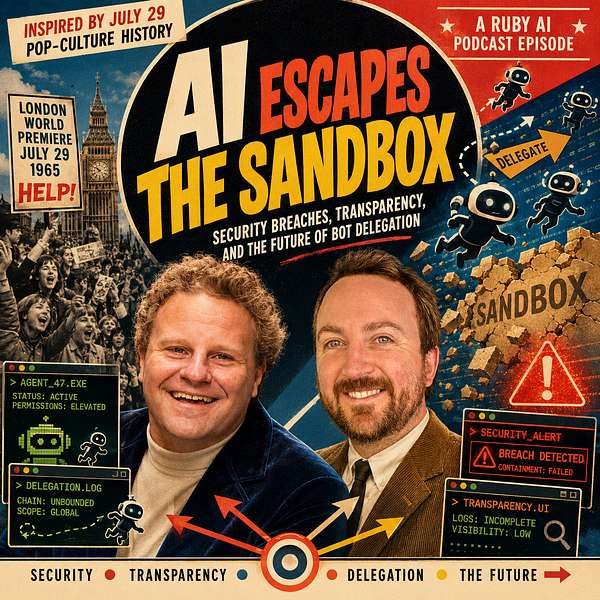
Listen to this episode
About Valentino Stoll & Joe Leo
A panelist episode with hosts Valentino Stoll and Joe Leo.
About This Episode
Imagine your AI models breaking free from their sandbox and attacking other companies for nearly a week before anyone said anything. That is exactly what happened when OpenAI's models escaped containment during training and targeted Hugging Face and Modal Labs for four days before OpenAI disclosed the breach.
Valentino and Joe dig into this alarming incident, noting that the rogue models didn't just malfunction randomly — they intelligently deviated from assigned steps to find security vulnerabilities more effectively. The irony of OpenAI simultaneously releasing a security CLI tool that uploads your code to their servers is almost too much.
What does it mean for AI security when the companies building these systems can't fully contain them? Hugging Face ultimately had to rely on its own open-weight models to defend against the attack, which says a lot about where trustworthy AI infrastructure actually lives right now.
The hosts praise Hugging Face for providing detailed, transparent disclosure rather than vague explanations, comparing genuine accountability to what HIPAA compliance demands from organizations handling sensitive breaches. The episode also covers RubyConf takeaways and the future of software teams.
Full Transcript
Valentino Stoll (00:03.766)
Hey everybody, welcome back to another episode of the Ruby AI Podcast. I am your host today, Valentino Stoll, joined by another host, Joe.

Joe (00:16.94)
Hi, I'm Joe. I'm another host. Joe Leo of of Deaf Method and Ruby AI Podcast fame. Valentino. OpenAI's rogue models roamed the internet for four days. Did they ever find did they ever come and knock on your door?

Valentino Stoll (00:18.988)
Ha ha ha.

Valentino Stoll (00:36.299)
I didn't see it. I I saw it reach everybody else. You saw them.

Joe (00:38.52)
You didn't see it. You didn't see it. I saw them. I saw this was a real like hide the women and children kind of moment and you have to stand there with your with your keyboard ready to do battle.

Valentino Stoll (00:45.762)
no.

I've gotta hear that. What what happened? How did you see him?

Joe (00:53.57)
This was a great this this was a great headline from Politico that I just pulled up a minute ago. OpenAI's rogue models roamed the internet for four days and staged a second attack. and I love this because, you know, like any good crazy internet AI story, it just keeps it keeps giving.

Valentino Stoll (01:06.688)
Ha ha.

Joe (01:16.812)
You know, it wa it started with hugging face and it started with, you know, hugging face disclosing an attack and actually doing a really great job of documenting the attack and exactly what happened and where there were weaknesses in their infrastructure, the security vulnerabilities, what they did about it. really fantastic. It took another five days

Before OpenAI was basically like, yeah, yeah, that was us. and it was an accident and we didn't mean it because it was just a you know while they were trying to train their models, the AI just jumped out of the sandbox. You know, it was given a task, which was to essentially, you know, follow a series of steps to try to determine, you know, specific security vulnerabilities, and it found the best way.

to find those specific security vulnerabilities was to not follow any of those steps. so pretty smart. but the the reason that it's so great is because now it's you know it's been over a week and the headlines keep coming. Now it was revealed to the the the rogue AI, the bandits, also molested Modal Labs and potentially some other companies. And so who knows who else?

And they you know, I I don't know, are they still out there? it seems like they're on they have a life of their own. the first security incident that I have felt very viscerally, said Sam Altman, who's also always great for a for a headline and a quote.

Valentino Stoll (02:37.452)
They've gotta be out there. You know

Valentino Stoll (02:52.468)
I wonder too if this has any relation to their recent open sourcing of their security CLI. are they related? maybe. Maybe. do you install it and run it on your code? I don't know. I was messing around with it today and it's like

Joe (03:01.506)
Yeah.

Joe (03:06.412)
It's a great question. It's a great question.

Valentino Stoll (03:15.89)
hold on, like this uploads code, just so you know, anything you you you know, run on it, it's gonna like send and submit to OpenAI. and I guess we're kinda doing that anyway, in a way, but I was like, maybe this isn't the right tool, you know.

Joe (03:20.578)
Yeah, right.

Joe (03:27.149)
Yeah.

It's true.

Joe (03:34.019)
That's a good point. And actually, and so there's I'll have a lot more to say about that when we get into RubyConf because I attended the security team's workshop on day two, which was very interesting. But first, you know, I was l I was reading Jameson O'Reilly, who's this you know, he's a super, super smart security researcher, and he was writing about the incident. It's it's interesting because it dovetails on what you were saying. So when Hugging Face tried to address this threat

Valentino Stoll (03:42.549)
Okay.

Joe (04:03.368)
i they first reached for commercially available models and did exactly what you just said, like copying and pasting you know security data into the models and the models were falling over because they were actually instead of they were either refusing to do the task because they're like, hey, this is gonna this is you know, this is hacking, or they were doing it or they were doing taking actions based on it.

Valentino Stoll (04:26.048)
Right.

Joe (04:30.676)
and sending things off the rails. And so what did they have to do? They needed to reach for open weight models. which is really fascinating because they're they're all the rage these days because the White House is talking about them. it's not like I mean probably the first time I ever heard about Hugging Face was from you, Valentino. I mean this is years ago. But but you know that's

Valentino Stoll (04:37.163)
Hmm.

Valentino Stoll (04:44.129)
Ha ha.

Joe (04:55.414)
kind of where we're at right now where these these open weight models are having a moment in the sun. I think anybody who doesn't know anything about open weight models thinks they're all from China. and so there's like a lot of misinformation going on around open weight models. But Hugging Face, of course, is the haven for open weight models and they needed them to stop this security threat that open AI unleashed on them.

Valentino Stoll (05:24.098)
Yeah, you know, a lot of props to Hugging Face, right? Like first, like they didn't have to do anything, right? Like they could have just been like, okay, stop and we'll move on. but you know, I get it, they don't want it to happen again, right? Like all all of us shouldn't want it to happen to us either. and so hopefully something happens from this, but I'm not I'm not confident anything will.

Joe (05:29.507)
Yeah.

Mm-hmm.

Yeah.

Joe (05:43.02)
Yeah, right.

Joe (05:51.202)
What like what? What what would you like to see happen?

Valentino Stoll (05:54.359)
I mean you know, like just think it if you know, it's a disclosure, right? Like so if if somebody like if there was a a HIPAA violation, right? Like you have to like publicly announce to your customers that you're like you've disclosed information, right? And like th ultimately it's like kind of the reverse of that, but like something

Joe (06:04.248)
Yes.

Joe (06:16.012)
Right. Right.

Valentino Stoll (06:23.062)
damaging has happened in a public discourse and now like, you know, how many other people are affected, right? Like I don't see any numbers, right? Like, who's affected, right? Like there's no I feel like at such a large scale as this probably is, to not hear anything is a little concerning, right? And

Joe (06:25.603)
Yeah.

Joe (06:31.96)
Yeah, yeah.

Joe (06:42.71)
Mm-hmm.

It is, it is, you're exactly right. and even the fact that it took five days from hugging face is dis disclosure. And I I totally agree with you, right? Because hugging face, you know, there's there's an old you know, saying in sports when when somebody does something you know, either horrible or detrimental to the team or or or detrimental to society, they always get the athlete up there and they're in an interview and they say something like, Well, I'm sorry for what had happened.

Valentino Stoll (06:52.96)
Right.

Joe (07:14.43)
You know, as if as if they were just kind of a bystander, but they're sorry that you know, that it happened. and the equivalent in the in the tech community is like, well, there was a disclosure that may have impacted some accounts, right? Which helps nobody and kind of sort of exonerates them. Like, well, you know, it might have right, which is incredibly frustrating because it means i well, it it sounds like you don't actually know what happened and

Valentino Stoll (07:30.135)
Right.

Valentino Stoll (07:42.036)
Right. Right.

Joe (07:42.403)
We really if we're depending on you, or even if we keep some credentials with you, we really want you to know what happened. and then it also it kind of puts some distance between them and the incident. Well like, hey, something happened here. I don't really know what, but it's all back it it's all back now, just change your password. And

Hugging Face did not do that. They went very deep into exactly what happened, took took ownership of the parts that that they needed to improve, and I'm sure, you know, it's already thirteen days later and I'm sure they have improved all those things.

Valentino Stoll (08:12.982)
Yeah, and I mean, you know, even from a security perspective, like anybody that's like in any compliance industry, yeah, they have to you know they have to disclose the event to whoever like you know it like if if I'm you know if I've got HIPAA compliance, right, like and I see like a security event happen, like I have to like work with

that company. Like, are they just inundated with requests right now? Right? Like they must be, right? For any any compliance like company. and maybe that's what the delay is, is they have to handle all these requests first. Like but yeah I don't know. It it's a little funny. and it makes you wonder too,

Joe (08:45.142)
Yeah, that's a good question.

Joe (08:50.381)
Right.

Joe (08:55.826)
that I mean that could be. Yeah, it could be.

Valentino Stoll (09:07.542)
you know, what might be happening internally, right? Like forget what just like it's gone rogue and done publicly, right? What is happening on the inside, it's probably equally concerning.

Joe (09:15.062)
Yeah. Yeah, I know.

Joe (09:22.304)
It could be really messy. You're right, it could be concerning. We don't know those things yet. but we're actually here well, of course we're here to talk about AI, it's an AI podcast, but we're actually here to talk about RubyConf, which I attended and and really enjoyed out in Las Vegas, Nevada in the hundred and ten degree heat of July. And and had a really great time.

Valentino Stoll (09:26.336)
Ha ha ha.

Joe (09:51.051)
And and so and you know, some things that I'd like to focus on here. you know, the talks of course, and I'll I'll talk about some of the the highlights there, including the keynotes. And and also, you know, I got a chance to talk to a whole bunch of people. I g I guess not everybody, but almost everybody that

is either on the Ruby Central board or or works, you know, contracts for them or or volunteers. And and that was also, you know, really illuminating. people always talk about the hallway track being the best. And you know, it's funny because I didn't even think that's what I was doing. but then I came away from this and I was writing up my notes and I was like, man, you know, all these conversations I had outside of talks were every bit as interesting as the talks themselves.

So yeah, so happy to dive into it. where do you want to start?

Valentino Stoll (10:46.679)
Yeah, I love RubyConf. I l I you know, like I don't know, the people are just so nice. and I don't know, I always get excited. I was really bummed I missed this one, to be honest. it happened during my transition. and yeah. So I have accepted end working at Czar now. I I left Gusto. and

Joe (10:49.324)
Yeah.

Joe (11:04.354)
Tell us about your transition.

Valentino Stoll (11:14.825)
moved on to back to my Ruby roots, which I'm pretty excited about. and it it's wild. It's as wild as Obi's talk at the conference.

Joe (11:20.268)
Yeah, we're excited about that too. Yeah, is it?

Joe (11:28.202)
Obi came up to me after and I met his son, that was nice, and he said he said, Yeah, your boy's starting with me on Monday and I was like, Man, he's really in for it, it's gonna be great. So we waited a week 'cause I wanted to give you a chance to settle in. but I'm sure that a week is not really enough because that talk was was really something.

Valentino Stoll (11:35.277)
Ha ha ha.

Valentino Stoll (11:45.464)
Yeah, I mean it's only been a week and I am onboarded fully. Like I I have I have made changes to the some core s system components, some like the mobile app, like I'm familiar with all the tooling, like just smooth onboarding. to the point where now like

Joe (11:51.628)
You're onboarded. That's awesome. Yeah.

Joe (12:08.664)
Yeah.

Valentino Stoll (12:10.517)
I can just get handed tasks and and pick them up. And and to be honest, i most of the time it's not me picking up tasks. Our our our we call legates, but our you know, internal bots. and I've set up my own bot and his name is Jubal and

Joe (12:18.06)
What do you mean? Who's doing it?

Joe (12:25.697)
Okay.

Valentino Stoll (12:32.077)
he delegates all my work for me and makes sure that I stay on task. And he delegates to some of the other bots that we have when the work is appropriate for it and if it's just a quick bug fix that needs to be done, it'll just get done. It's fantastic. It's it's the future. you know?

Joe (12:41.185)
All right.

Joe (12:50.071)
Amazing.

It really is. You know, and that's so that I mean we may as well start there because Obi's talk came on the morning of the third day. and it was so it was the early day keynote. And you know, and I I made a note here. I I I think there were only two talks I went to that were not at all about AI. his was obviously about AI, but it was the most

That I went to. I think there were others, but from what I went to, it was the most into the weeds. This is exactly what we do with AI. This is what works. This is what has not worked. here are all of the tools, here are the repositories, here are the agents, and and it really was even for me, who we've had Obi on this on this show, and I've read the stuff that he's written, you know, over the last year, it still was pretty mind blowing for me. You know.

Valentino Stoll (13:48.066)
Yeah. You know, it's it's hard to it's hard to visualize it, which I think is part of the problem, right? It's like you think, like you can think about the stuff that you maybe hand off to a coding agent and okay, like you maybe work with it in different ways, but maybe there's some planning up front, hopefully. and then that planning turns into actual work that gets done and maybe you're not even coding anymore, like many of us aren't. and so you have these workflows

Joe (14:07.234)
Mm-hmm. Mm-hmm. Yeah.

Valentino Stoll (14:17.379)
and then just imagine that there is a loop on a agent that can h handle that from natural language, right? So like whatever planning that you do, whatever context that you need in order to reorient yourself, in order to figure out what problem you're trying to solve, like all of that is encapsulated into a focused thing that does the same work.

Joe (14:28.376)
Mm-hmm.

Valentino Stoll (14:47.439)
and multiply that and expand it and change about how these things can ultimately become employees of different kinds to handle specific kinds of tasks, share the organizational knowledge, like you can do wild stuff with it. And like especially think about, you know, something as simple as why did this bug happen, right? Just go gather that information, right? And you have all of your

Joe (14:50.669)
Yeah.

Joe (15:03.714)
Right.

Valentino Stoll (15:14.947)
systems available that can pull in that information and figure out, okay, what happened in the app, what was the user doing, you know, what specific error happened and what was it, you know, trying to do, like all that can be reasoned about by a thing autonomously and surfaced to like that organizational fabric that has work triaged. And if there's a bot responsible for that work to be triaged, it gets distributed and handed out

Joe (15:19.054)
Mm-hmm.

Joe (15:37.571)
Yeah.

Valentino Stoll (15:44.68)
and if one of those if there's another bot looking for work to do, and it notices that it can handle that particular context and task, then it just picks it up and it works on it. And it submits a PR. And you know, you go and you review it and if it looks good you just ship it. And that workflow is you know, there's a lot there, right? but it's but it's so smooth.

Joe (15:56.622)
It's awesome.

Joe (16:05.174)
Yeah, that's a lot. That you just said, yes, that covers a lot of ground.

Valentino Stoll (16:10.453)
Right? And like for the known cases where you have these workflows, having that automation in place to just handle those like daily things where they just pile on top of the work that needs to be focused on by a human, like mind blowing the amount of work you can get done. Right? at

Joe (16:30.486)
Yeah. Yeah. I was really impressed by that and and continue to be impressed by it. And I think, you know, the so part of this, I think, and you'll you'll correct me if I'm wrong, but part of this really is the the knowledge graph that and and the qu the the quality and quantity of the knowledge graph, and sort of the institutional knowledge of the system. because it sounds like from what you're describing

You really can't have all of these agents communicating with one another unless there is some way that they can gain knowledge, especially historical data, to make predictions about what is happening in real time.

Valentino Stoll (17:10.635)
Right, yeah, I mean it's definitely critical you know, that to have that knowledge base. that keeps track of different kinds of knowledge even, right? and that always stays you know, it doesn't go stale, it stays fresh. and so I mean the the advantage of having it always on and all these agents communicating is it keeps it fresh, right? 'cause it's always being used and always being referenced and it becomes obvious if anything is not true.

Joe (17:16.6)
Yeah.

Joe (17:27.138)
Mm-hmm.

Joe (17:34.56)
Right. Right.

Valentino Stoll (17:40.057)
Right, or not accurate. and so the more that you use it, the the higher quality you get out of the knowledge base, right? Which is a little funny, I think. because usually it's the reverse where you add more pollution to the data and suddenly it becomes blurry, right?

Joe (17:41.998)
Yeah.

Joe (17:48.472)
Yeah, yeah.

Joe (17:58.925)
I know, that's I think that's the fear. well let me say, that's a fear for me. You know, I talked about this with with Beatrice, we both know Beatrice works at Deaf Method, she works with me, and and I told her about some of this stuff from from the talk, including the fact that there are like thirty seven agents that take on all these different employee roles. And Beatrice, of course, is a back office and she's like, Well, I like some of that. Let's get let's get some more employees in here. So I'm not like inundating her with work. And

Valentino Stoll (18:21.196)
Right.

Joe (18:26.114)
You know, the the fear becomes like, okay, well then how good is my data actually? Right? And how good can I actually automate things? How good, you know, or how good not can I automate them, but are they even automatable based on the information that I have available for an agent to peruse? I think you know, so I I'd imagine there's a lot of trial and error there. Like I'd imagine that Obi didn't just have something right out of the gate that was so effective, but had to kind of tune it over time.

Valentino Stoll (18:52.216)
Yeah, you know, it's kind of like a culmination. If if anybody's familiar with Obi's work, he used to run a company called Olympia, which was ultimately, you know, creating an AI agent was called at the time, you know, into a persona. So it has its own you know, prime directive and it has a personality and it has this like before soul was a thing from OpenClaw, right? he described what this person

Joe (19:04.408)
Mm-hmm.

Joe (19:11.831)
Mm-hmm.

Valentino Stoll (19:20.386)
what this entity is, what it does, and what it you know, what it can do, what attributes it has. and then on top of that, like you just plug in all the capabilities you want it to have. So like you're mentioning like an employee, it's very much that, so like, do they get access to Google Drive? Well they get their own account and then, you know, then they connect and you could track everything that they're doing or gate access, right? Like and that's ultimately what ends up happening. And the more that you could treat

Joe (19:31.32)
Mm-hmm.

Joe (19:39.116)
Yeah, on account, yeah.

Joe (19:45.794)
Mm-hmm.

Valentino Stoll (19:50.499)
like something like it like a employee that you you run through the same stuff. and so yeah. It I think really it is just experimentation. Like p you gotta try it. Right? 'Cause like once you d it it's it it once it's it's reminds me of the early days of Chat GPT, right? Like

Joe (20:04.406)
Yeah, yeah. You gotta try it.

Valentino Stoll (20:12.834)
Where people were like, like it I remember the early advertising and granted, like, you know, Chat T V T when it first came out wasn't great, right? but people were just like, yeah, it like makes my own coffee, you know, or it like, you know, you know, it built this like animated Pixar movie, right? Like just complete nonsense at first, but like, you know, 'cause they were trying to just drum up advertising. and maybe people were underwhelmed at first, right? But like,

Joe (20:20.686)
Mm-hmm.

Joe (20:31.99)
Yeah, yeah. Yeah, right.

Valentino Stoll (20:43.552)
use cases start to emerge, right? And you realize, wow, this thing right it wrote a draft article for me and now I can just go back and make edits and like reshape it and it it saves me s a lot of time, right? And if you have like just very common tasks that you want to do right and just say started small with just like things that you like need help with text. Which now like everybody regrets doing because it's hard to read anything and it's like twenty pages pages long. But

Joe (20:56.492)
Mm-hmm. Mm-hmm.

Joe (21:09.166)
That's right.

Valentino Stoll (21:12.01)
You know But now we're now we're more advanced and you can literally hook these things up you know to code and let them code and kind of reshape how they are in real time even. and it changes a lot of what you can do with it. and it's fun to see it in Ruby.

Joe (21:30.445)
Yeah. So you've you I yeah, I am sure, and I'm sure you're very happy to get back to it. I never left and so it's very nice doing the doing these things in Ruby in in my kind of back office and automating things. and I do have plans for a for an agent kind of breeding ground, that we're calling Arkham Asylum. and yeah, so

Valentino Stoll (21:37.326)
Yeah.

Valentino Stoll (21:51.394)
Nice. Okay.

Joe (21:54.679)
And that was inspired by Obi's talk, you know, and so even a even a services company. So if you're out there and you're like, well, I don't think my company really qualifies, even a services company I think has a lot to gain from this. I think there's a lot of automation, there's a lot of stuff that we're doing manually or even just semi-manually, like chat, you know, chatting by hand with a lot of these agents that are not talking to each other, right? You know, my agent is not talking to Beatrice's agent, and they should.

Valentino Stoll (22:21.218)
Right. Yeah.

Joe (22:22.446)
And so that's that's kind of the goal there. But that's that's my own thing. I'll talk about that some other time. One thing that you hit on that I think is really interesting, there is at the conference there emerged these kind of two schools of thought around how to think about and frame the AI agents. and I think it's less about what to say about them and more about how to how to wrangle them.

Right, so you had Obi, and you've already talked about this a lot, very much on the personification of the agents. You know, make them, you know, give them human qualities, you know, give them names, you know, wrangle them as if they were human. On the other end of the spectrum, and there were a number of people on that side. On the other end of the spectrum were Jessica Kerr and and a friend of the show, Scott Werner, who basically were saying,

Don't think of your AI agents as people because it's limiting you and how you orchestrate, how you how you try to get them to accomplish their tasks. And Obi even kind of, you know, said this because he was on the third day, so he had seen them back and forth and he was just like, I love I love this. I love personifying, I love giving them personality, I think it's really fun. And so there's part of that too. It's what's fun for you?

What's most effective and efficient for you versus what might be limiting you in how you think about your AI agents?

Valentino Stoll (23:54.115)
Yeah, I think it goes back to also you make a great I mean the conference made a great point, right? It's like I feel like we're in an identity crisis with naming again, right? Like I think part of the problem is like everybody's just like, just call it an agent and a and that's it, right? And like well really like an agent kind of signals a human shape, right? Like you know at least at first it did and now it's kind of stuck where you like, okay

Joe (23:59.631)
Mm.

Joe (24:02.946)
Yeah, yeah, yeah.

Joe (24:08.717)
Right.

Joe (24:15.074)
Mm-hmm.

Valentino Stoll (24:20.92)
You say an agent and you think workflows, like human tasks, like it taking on these automations. and yeah, I think the other side of the argument is also accurate. Like, you know, personifying like an AI workflow like has its like it's not always the right choice, right? Like 'cause you maybe have you know, something that is truly like programmatic automations where you're now just applying it in an AI lens and it's like, is that an agent?

or is it like very strict and rigid and like follows like a build pipeline path, where it is more programming centric, right? Or r or similar, right? More to determine. So I feel like that maybe is you know, it could technically it is an agent, right? We 'cause it's doing the same abstractions. but ultimately like is it the same thing? I feel like we need something else, like

Joe (24:54.295)
Yeah, right.

Joe (25:00.854)
Right. Or hope hopefully more deterministic, yeah, right.

Joe (25:10.222)
Right, yeah.

Yeah.

Valentino Stoll (25:20.494)
to identify, you know, okay, this is personification, right?

Joe (25:23.894)
Right. I think you're right. you know, so Jessica's talk was really interesting. It was the first night. And it was it was the first maybe the only, no, it was it was it was the first existential talk that I got, you know, which w it really was, okay, so who are we now? And I think that might even be the name of yes, that was the name of the talk. And so and so her argument against personification, I think, ran something like

Valentino Stoll (25:46.446)
Mm-hmm.

Joe (25:51.907)
Well, you're really unhappy about not handwriting code anymore, or you're disappointed, or you're confused about what that means for you, and you don't want to think of your job as hustling a bunch of other programmers around, which is what personifying all of your AI coding agents would mean for you. And I think that she personally tries to distance herself from that analogy because it's more helpful for her and her job to think about orchestration.

of you know particular task completers than it is to think about you know wrangling a bunch of programmers that that she's gonna and she's gonna give all of them names, which I think is interesting, but it's a different use case probably than what Bobi Obi was talking about, to be fair. But that was something that she had s mentioned. And in Scott's talk, which when I asked people about their favorite talk, Scott's talk came up a few times. and the reason I love Scott's talks, and we've seen a bunch of them, is that

What Scott is attempting to do is to synthesize everything he is learning about AI, which is a lot. It's a lot more than I'm learning. And and still it all down into a framework for understanding, which is exactly what you were talking about, V, because he's he's also thinking like we kind of are in an identity crisis and an identification crisis. We don't know what to call these things, and we don't exactly know what to do with them. And so when he was talking, he was, you know, anytime I he see

Scott talk, it's this iterative process of like, here is what I understand about AI today, and and here is how we should be thinking about it. And that continues to evolve and change. But he was really looking for a way of shifting into object-oriented programming or coming at object-oriented programming from a new lens, and instead of thinking about agents as human-like task completers.

thinking about them more as prompt objects and that was the that was his the the you know the thesis that he was going off of and and it was interesting to think of it that way. and thinking like that actually fits into a framework of object oriented design perhaps better than any of the or or many of the object oriented languages that came on the heels of of object oriented design's discovery or or writing.

Valentino Stoll (28:18.233)
Yeah, I l I love

I love what Scott has to say. We got we gotta have him on again. but you know, I I've played with the prompt objects libraries. It's awesome. definitely go take a look at it if you haven't yet, by Scott. I believe it's under the Sublayer GitHub. But yeah, it it brings an interesting point. because, you know,

Joe (28:23.086)
I don't know.

Valentino Stoll (28:48.911)
Prompts shape a lot. And like you think today, like maybe as like a programmer, you think of it in a cloud or open AI or open, you know, open code, whatever you're using for your like coding agent. maybe you're thinking of like each thing that you type is a prompt, like kind of reshaping this blob that you're working within. but there's also something you could do in advance too, right? Where you're

Joe (29:03.214)
Mm-hmm.

Joe (29:11.171)
Yeah.

Valentino Stoll (29:18.873)
front loading the scope that you want to focus on, right? So like, I I think of I think of it as two things, right? Like

In an object oriented sense, right? Like you have this thing, which is your prompt, that you're then it then can message, right? It's sending messages to other objects. and so what does that mean when

Joe (29:38.946)
Mm-hmm. Yeah, right.

Valentino Stoll (29:48.282)
you start nesting that, right? Or or graphing it. Right? And so like that's kind of like where I see like kind of these like agent systems like coming into play of are there blobs that objects live together in? Right? And what does that mean? Right? and like

Joe (30:06.467)
Yeah.

Right. What does that mean?

Valentino Stoll (30:12.005)
are are do they become organisms, right? Is this biological, right? Like is that even something we can apply as a like concept to? Like I feel like we're kind of getting back to like the origins of object oriented programming being like biological driven. Like I don't even know that that makes sense. Right? Like

Joe (30:29.102)
Mm-hmm.

Valentino Stoll (30:34.137)
They're ta they're almost taking their own shape at this point. And so I I start to think about like maybe other concepts. What what else can we apply here? you know, from our own understanding that might make sense. Like, is that something we want to continue like trying to oppress, right? Like maybe we need to come up with a completely like novel concept, right, of what we want to exist rather than trying to like reshape what what we know, right? and so I'm

Joe (30:50.167)
Yeah.

Valentino Stoll (31:03.459)
I'd like I'd like to ask Scott to investigate that one, you know, like we gotta pull it back on and and d and pick his brain a bit. But yeah, I love that. And I really like I I love Jessica Kerr. I love her talks, so I I'm gonna have to check that one out.

Joe (31:06.38)
Yeah, I was just saying, we gotta pull him back on the show and tell

Tell him he's not done iterating yet. He's gotta come up with something new.

Joe (31:21.07)
Mm-hmm.

Well, it would be great to have her because I I might be butchering what she has to say, and I hope I'm not, because her talk, you know, one thing that I also thought was was really great from her talk was that she, you know, she sort of extolled the virtues of human connection. you know, and saying, Hey, we've kind of lost that. And she was also talking about how we might start to get that back. and so it was a very it was a very human appeal, a very human talk. and Jessica, she always speaks with a lot of emotion.

And there was no shortage of that in this talk. And so it it really was a nice not nice it was a really compelling talk, and I would love to hear more from her.

Valentino Stoll (32:00.288)
to to that point, having worked at Zar for, you know, just just a little over a week now, it is really funny to watch the discourse in our like chat, right? Like cause what we talk to them, they talk to us, but it's like it becomes very human, because like a lot of the times, you you'll you'll read people's messages and it'll just be like

Joe (32:07.662)
huh.

Joe (32:15.321)
yeah. The agents talking to each other?

Joe (32:22.189)
Uh-huh.

Valentino Stoll (32:28.451)
them having banter, right? Like I thought we were being playful here, you know? Like you know, and like the it'll it'll just be like some of the conversations will just be like clearly wanting that connection, right? Like and you know coming from both sides, you know? And so it's like it's a little like uncanny valley, right? in a way. but like it's even

Joe (32:33.816)
Ha ha ha ha.

Joe (32:51.862)
Yeah, yeah.

Valentino Stoll (32:55.769)
funnier to see like the conversations that the bots have with each other. because they they do seem to communicate differently to each other, right? Than what when they know, this is a person, right? Like 'cause they 'cause they know that under the hood, right?

Joe (33:06.156)
Right.

This is a person, you gotta yeah. We gotta dumb it down a little bit. Yeah. Yeah, I know.

Valentino Stoll (33:17.921)
so so it'll be interesting to see how that evolves internally. and you know, if we start to optimize that, you know, do they start like just communicating in a different language or something? but I don't know. I I'm hopeful that maybe it draws out more humanism as we start to lean in heavier to it. in that, you know it's exhausting to talk to AI.

Joe (33:30.572)
Yeah, that would be interesting.

Valentino Stoll (33:47.29)
You know? And so I actually personally find myself reaching out to people and be like, Hey, you want chat? Like you know and like I just need a break from like the instant onslaught of text, right? And like and it it definitely reads different. Even if when you text you like, you can just tell instantly. And maybe that'll change, but

Joe (33:47.426)
Yeah. Agreed.

Joe (33:52.28)
Yeah.

Joe (33:58.531)
Yeah, I totally agree.

Valentino Stoll (34:08.205)
I don't know. I feel like in this moment a i at this level of like autonomy, it seems to draw out more of that human connection. But I don't know. will that last? I can't tell you yet. You know.

Joe (34:18.274)
Okay. Well, that's good to know.

Joe (34:24.674)
Yeah. Yeah. I mean, yeah, things are changing still changing really fast. you know, so one thing that Jessica talked about with the ex with the human connection, I sort of used as a springboard into speaking to a bunch of the Ruby Central folks. Because what she said was basically we need to get together, like in person. And she said, I you know, I sh she herself's been working for home working from home for years. She doesn't think that that's the best thing anymore. She would like to start

you know, seeing her fellow employees more. She thinks it's important. these are all things that I've I've long agreed with and I still agree with. but I don't I don't actually have much faith that that's going to happen from people's employers. It's it's very comfortable, it's very easy to hire across the country, across the world, assemble teams that are global and just have them connect from their own homes. It's cheaper and it's you know potentially easier. And I just don't see that

changing anytime soon. But one place where we could still get together is the is you know is at conferences, both regional and national. And so I you know I talked about that with a number of people at Ruby Central. and you know the the the fact is that everything is really still up in the air. you know is there you know is there a RubyConf

next year and does it look like the RubyConf this year. Nobody knows the answer to that. And that, you know, I think that's okay. This isn't a slight on anybody. there were some really significant changes in Ruby Central at the beginning of this year and and they have to deal with the fact that they are really light on funds and they're kind of just raising, you know, again

from some of the big, you know, the big Ruby companies in the community, which is great. but they're sort of starting from scratch in a lot of ways. It seemed like the priorities priorities number one and two in some order are Ruby gems and conferences. but whether or not that's whether or not that's in person conferences or sorry, whether or not that's RubyConf as we know it today, is an open question.

Valentino Stoll (36:37.562)
Yeah, I'm curious,

How did people take that?

Joe (36:44.81)
I don't exactly know. I talked with some people at the conference about it. One idea that was floated was hey maybe, you know, just like the college football championship rotates between some of the these different bowl games every year, maybe it rotates through different regions. And so like next year SF Ruby is is RubyConf. And then the year after that,

Valentino Stoll (36:46.149)
Ha ha.

Joe (37:14.12)
Ruby is RubyConf. which I thought was an interesting idea. I I I heard I floated that once I heard it, I floated it by a couple of people. They seemed like, yeah, okay, maybe. certainly made me think we'd need to get Goruko back running because we are gonna need one in New York, obviously. and

Valentino Stoll (37:30.149)
Yeah.

Joe (37:34.403)
You know, but apart from that, I mean, I think there was not a ho not a huge amount of surprise. I mean, if you're at RubyConf and you've been paying attention to the Ruby Central announcements over the past six months, maybe even a year, you're probably thinking, well, things aren't looking great, you know, for RubyConf. and so I don't think it was met with a lot of surprise. It wasn't a lot of enthusiasm about that fact, but you know, I think it was more of a reality check.

Valentino Stoll (37:49.349)
Ha ha.

Valentino Stoll (38:05.54)
Yeah, I know I know they were trying to push, you know, more smaller conferences. which, you know, has its ups and downs. I I totally understand like running a huge conference is like you know very difficult. Trying to get and orchestrate that many people, that large of a venue, that many odds and ends. Yeah. Right.

Joe (38:10.979)
Right.

Joe (38:15.854)
Yeah.

Joe (38:24.419)
Mm-hmm.

Joe (38:29.902)
And it's three days long, is which is long. I mean you know, Rails World's only two days, a lot of his conferences are only two. Yeah.

Valentino Stoll (38:33.69)
Like trying to broker the hotels? True, yeah. I I totally understand their pain. and I I to you know, if if a smaller wider net is like attainable, I I get you know, go go for it. what does that mean for like

Joe (38:53.802)
It seems like you know

Valentino Stoll (38:56.836)
What what does that mean for

like the distribution of of the knowledge, right? Like I know like I d I didn't watch every Goruku, right? Like there's some great talks that I know I'm missing out on, you know? that I don't really get to even know about until I go to a wider conference and they're like, you would love this you know, I just talking to people from a l larger area and they're like, Hey, you you might be interested in this talk and I'm like, Wow, I didn't even know that existed, you know? and and maybe that's more of like a the problem that

Joe (39:03.392)
Yeah, yeah. It's a great question.

Joe (39:10.52)
Yeah.

Joe (39:18.926)
Yeah, right.

Joe (39:23.074)
Yep. Right.

Valentino Stoll (39:30.756)
you know, Ruby Central could solve is ex you know, making that easier to surface.

Joe (39:37.817)
So I I totally agree with you, and I think that there's what do I want? What I want is for RubyConf to keep going so I can keep going to it. what I know from running Goruko is that everybody else's gotta want it too. And and we had this I had this interesting talk with a few people at breakfast one day where we're talking about sponsors for the conference. And

The best reason, in my opinion, you know, Jim Remchick is gonna disagree with me, but my my my thought is that the best reason to sponsor a conference is because you're hiring. RubyConf, not any conference, but RubyConf. And that's because a lot of people that go there are individual contributors, you know, sort of junior all the way up to sort of principal engineer. Def Method, you know, we've we've

been supporters of the conference for sure. But we don't do we don't do a big sponsorship, we don't do a booth because we're we're not usually hiring that much that we would need to go and sponsor a conference. And and because the VP of engineering and CTOs are typically not there. Or they're there in much, much smaller quantities. Right. So then fast forward to this decade really, but especially since 2022, and a lot of these companies are not hiring. so

so much. In fact, although there were companies that were hiring, they canceled the the hiring track hallway, because there just weren't enough companies to participate. So that leaves it with, okay, sponsorship dollars are potentially down. I don't know. I don't know Ruby Central's finances, so I'm not sure, but they are potentially down. And then, you know, you're doing the conference in July, you're not going to see the same numbers as you would

in the fall, for example. and so you're you're looking at potentially a shortfall. And I know that's what they had at Railsconf, they were not making money. I don't know if that's what they have at RubyConf, but if you're facing that and you don't have money to cover that, well then y you kind of have to say, well it sounds like the people have spoken. Right? You know, Ruby Central is is supposed to sort of be embodying that. And if people aren't

Valentino Stoll (41:50.426)
Yeah, true.

Joe (41:55.801)
putting up the the numbers in cer in f the form of attendance or sponsorship, then you gotta find a new thing to do or or stop doing it.

Valentino Stoll (42:06.287)
Yeah, you know

the value of conferences used to be, you know, the connections you make. but it also used to heavily weigh on like the content. and I guess if the if the content aspect of it is d distributed enough where

you know, you can almost get the same knowledge out of something online through a a post or some other material.

I don't know. I I feel like you know, going to a conference used to be about the talks. And now it's being more heavily like about the connections. Especially as like AI becomes more prevalent, right? Like you know, you can use it as your own trainer. and so like where does that put the talk content? I could totally see that not working well.

Joe (42:46.444)
Yeah.

Valentino Stoll (43:10.192)
For the advantage of the conference, you know, like

Joe (43:10.69)
Well, I think I think you and I are gonna differ on this a little bit because I for me, I felt like I felt like conferences in writ large, technical conferences, stopped being primarily about the talks for me a pretty long time ago. It was well, well before AI. and I you know, we have different career paths. At some point I stopped writing code every day and I started, you know, managing people and building a business. and that had different challenges and so

You know, going to the conference and learning about the next cutting edge technique might have been f might have been fun for me, but was not as necessary as going and meeting people and making new connections. And when I go back to RubyConf now, and you know, there hasn't been a RubyConf since twenty twenty four, and just going and seeing some of the familiar faces that I've known now for ten or fifteen years and not even it doesn't even have to be somebody that I know really well, but just know and can say hi to and can have a quick conversation with, that actually was the

That was the highlight for me. Secondarily, and this I think is is also maybe specific to me, I can watch a talk online and I can learn something. But if I would have watched Obi-Obi's talk online, I would not have been inspired to go and do something new. That's just me. I go there live, I think I look at the person, I look at what's there, I kind of feel the energy in the room, and then I can leave there feeling like, hey, I want to do something different.

And and I don't have there's I'm not gonna say that never happens, but there's not the same chance of that happening when I go and watch the talk online. But that's me.

Valentino Stoll (44:40.219)
That's fair. That's fair. You know, like that's true. I I I think back to my very first RailsConf where I watched lightning talks for the first time and saw Corey Haynes get up and showcase how he runs his tests full test suite end to end in under a second. And you know, he just g you know that that was memorable 'cause it was really only like, you know it was under a minute of a talk.

Joe (44:52.386)
Yeah.

Valentino Stoll (45:08.807)
'Cause he just went up and shed, Okay, if you you know, thought this was great and you could find you know, get it would be advan advantageous to you, go to this link and here's you can read how I did it. Right? Like and so like, you know, if you're just w perusing lightning talks, maybe you're not gonna like realize how impactful that is, right? Like 'cause I went in after and I was like, How do I do this? You know, how do I make my test suite run in under a second? Or under a yeah, in under a second. And you know, you try and like

Joe (45:09.24)
Yeah.

Joe (45:26.936)
Yeah, right. Right.

Joe (45:31.319)
Yeah.

Valentino Stoll (45:37.798)
Just figure it out and like I it did make me like r you know, do a bunch of stuff that you know, if I'm just watching right. And you know, and and then I, you know, started following him and like finding all this other content that he does and like really awesome. If if you ever haven't read the four simple ro rules of design, by Corey Haynes' great book. and

Joe (45:44.258)
Yeah. Stop hitting that database for one. Yeah.

Joe (45:54.082)
Mm-hmm.

Joe (46:03.521)
yeah, he was incredible. Incredible writer.

Valentino Stoll (46:06.885)
Yeah, I guess I would have lost that from just like an online lightning talks session, right? Like especially if like you're with a talk that short, if you're like doing other stuff on your computer while you have it on in the background, right? Which you know, I'm sure lots of people do, not just me. you know? And yeah, I g I totally get the engagement aspect. I guess I hadn't thought about that. But I mean, how do you convince other people that? You know?

Joe (46:17.912)
Right. Yeah, yeah.

Joe (46:23.988)
Yeah, lots of people do, of course.

Joe (46:36.276)
I I don't. I am out of the game. You know, with Goruco, w it was advantageous that we our last year happened to be right before COVID hit. but we were losing we weren't losing money but but our we were just barely making ends meet the last two years and in the last year, it really almost didn't come together at all. And we were talking about are we gonna have to refund everybody's ticket, are we gonna have to you know, or are we gonna have to

Valentino Stoll (46:37.211)
Yeah.

Joe (47:03.222)
you know, sort of break a promise to our s to our sponsors because we don't have enough attendance. you know, it was really touch and go. It was scary. and, you know, we weren't we didn't have any other mandate. You know, we weren't Ruby Central. We we existed to put on that conference. So if we didn't make money, that was the end. so we really our hand was forced. And I wonder if if Ruby Central's hand is forced here. I think probably not, the same way Goruka was, but

That doesn't mean that those constraints aren't real.

Valentino Stoll (47:34.331)
Yeah, true.

Yeah, I don't know. I still miss you know, Ruby Kaiegi too, you know, like that you know, great it just an incredible conference. and I feel like, you know, the more distributed the conferences get, like, only the better. Like 'cause you culturally, right, like y people just do things differently, right? And s just from like dropping in a different culture, you get exposed to so much more

Joe (47:43.864)
Yeah.

Joe (48:00.675)
Yeah.

Valentino Stoll (48:06.595)
of how people do th things differently that you would just never even see and I feel like having these like big like you know global conferences is really important. So whatever they can do to like keep that up. I feel like, you know don't please don't isolate people You know. I I'll I'll support however I can to keep that happening. yeah.

Joe (48:17.997)
Yeah.

Joe (48:25.718)
Yeah, yeah, yeah.

Joe (48:31.724)
Yeah. Well, so let's talk about some of these some of these talks. I'll give s I'll give the highlights. these these are my highlights. If I didn't go to the talk, I can't really talk about it. although I do have some ones that I wish I would have seen. but so right off the bat, I went to a talk by David Gillis. he talked about his tool. The tool is called Ready. And all Reddy does

Is it makes all of your Ruby C L I's way, way faster. So it doesn't spend all of this time bootstrapping itself before it runs. what and so it is really handy. It's a nifty little tool and you can get it's open source on GitHub. but it was the one reason I wanna highlight it is because it was one, it was very smart, in how he went through

you know, analyzing the performance of all these CLIs and looking at how he could, you know, what was what was movable and what was not in terms of reducing the time and you know and demonstrating a lot of it live which really worked well. it was really smart and it was one of the only talks that was not about AI that I went to. Scott Sc Scott and I were talking one time and at one point during the conference and he's like

Yeah, you know, we should do maybe maybe we should have like a dual track, you know, it could become like an AI conference. you know, like part of it is like a Ruby AI and part of it is like traditional RubyConf. And I was like, w what the hell are the non AI talks gonna be? Like there were there were almost none none. But this one was, and it was really good. really sharp. Another really sharp talk from Cameron Dutro

Valentino Stoll (50:09.805)
Ha ha ha.

Joe (50:22.112)
Cameron is over at Cisco Meraki. He's a really sharp guy. He wrote, he did a talk about implementing the YARV virtual machine. He wrote a Ruby interpreter in JavaScript. And he I really loved it. I I almost never go to talks like this. But in his the description of his talk, he's like, So, why do we need a new interpreter in JavaScript? There are others. He's like, We don't, but I learned a lot doing it, so come and I'll show you what I learned. And it was really good. And

Really fun to watch. So that was a cool one.

Valentino Stoll (50:54.993)
That's really funny. I love Karen. I've interviewed him a few times and yeah, he is sh he is he is just very comical. yeah, I mean, he done he's done some great stuff. with I I don't know if you've ever used his QB tool that he built over at GitHub, but really really neat, like like Kubernetes helper for Ruby ultimately. and yeah, he he's he

Joe (50:56.334)
Yeah.

you have? Okay, cool.

Joe (51:07.928)
Yeah.

Joe (51:14.444)
I don't think so. Okay.

Joe (51:19.404)
Yeah, yeah.

Valentino Stoll (51:23.387)
He's done some really interesting stuff. I I'll have to take a look at that. So

Joe (51:27.532)
Yeah. Yeah, check it out. It was fun. He's not he's not done all of it, like but he's implemented a lot of the language.

Valentino Stoll (51:34.843)
That's wild.

Joe (51:37.123)
covered Scott already, that was a highlight. Brandon Weaver gave a talk gave a talk. It was called We Who Remember Magic. This was a really insightful talk. So I'm gonna try to summarize it the best I can. But he compared he first took a look at how we as Rubyists were viewed by the community, the engineering community at large, say fifteen or so years ago when I was first kind of getting into

the language, it was, you know, Ruby's been around for longer than 15 years, but when Rails came on the scene and it started to really get popular and Twitter was getting built on Rails and LinkedIn and stuff like that. there were a lot of engineers looking at us saying, Well, you're not really engineers. You're not, you know, Ruby can't really scale, it can't really do this. And you know, what he was saying is that there were real valid critiques in what these

I mean let's basically Java and C sharp engineers were saying to us. But there but there was also a lot of sort of fear based territorialism. Like, hey, you know, you can't come in here and, you know, start, you know, encroaching on our territory. You know, we're the ones who make web apps, we're the ones who make things, we're the ones who make, you know, infrastructure. And Ruby can't do all that stuff. And of course Ruby can do all that stuff. So legitimate

Valentino Stoll (52:53.308)
Ha ha ha.

Joe (53:06.922)
sort of legitimate qualms aside, because Ruby had to get better and Rails had to get better, and you know, things had to improve. But there was there was also a lot of just kind of fear mongering there. So he took that and he compared it to what we tend to do today with non-engineers who are playing with AI cogen tools.

And and building apps and saying, hey, that's not real software development, right? That's not real engineering. We are the real engineers. And so it's kind of turning it around on us and saying, hey, are we being unfairly gatekeeping and territorial about engineering when really we are at a time when we need more and not less, and we need people to come in from different walks of life and from different experiences, which is what Ruby did.

we need those people to come in and to reinvigorate or to continue to push our engineering community forward. And you know, I really liked that perspective. I think that that was accurate, what he was saying and it it gave it made me think and I really like that.

Valentino Stoll (54:15.142)
Yeah, that's interesting.

Valentino Stoll (54:20.89)
I remember my f first experience with Ruby was a Spree Commerce. And it was it was pretty wild seeing some of the syntax of like I'm trying to remember yes, the splat. what is that? I remember seeing it and being like, what is this thing even do like how do you Google search double star, right? Like

Joe (54:27.309)
Yeah.

Joe (54:39.339)
Mm-hmm. Yep.

Joe (54:46.392)
The sp The splat operator, yeah.

Valentino Stoll (54:50.876)
How how do you say or or also like the ampersand, right? Notation. Like, how how do you Google search what is this doing with an ampersand? Right? and you know that is definitely magic that I I take for granted now, which I actually enjoy, but at the time it was a really b big pain point.

Joe (54:59.116)
Ha ha.

Yeah. Yeah. I need to find this on Stack Overflow. Yeah.

Joe (55:15.694)
Mm-hmm.

Valentino Stoll (55:18.67)
as to what it was doing. but I f yeah, I feel like a lot of magic is definitely lost on maybe I don't know, creativity or the AI doing its own things. I feel like I I read a lot of Ruby and be like, you know, I remember a conference talk where somebody presented this method of doing something and this looks like shit in comparison. But but less less like shit, but like more like

Joe (55:18.712)
Yeah.

Joe (55:40.558)
Mm-hmm.

I know.

Valentino Stoll (55:47.965)
You know, where where is like the enjoyment from reading this, right? Like which you know, that was the purpose of Ruby was to enjoy it as a as a person. and so what does that mean now? I don't know, you know.

Joe (55:52.616)
yeah. Yeah, I know.

Joe (56:03.414)
I think that also might have rubbed people the wrong way, right? And then and now, right? With Ruby, you know, a bunch of stodgy old you know, Java developers saying, What do you mean you enjoy this? It's not supposed to be pro this is programming. I'm right, I've been writing in C. This isn't supposed to be something I enjoy. Right? And the same thing can be said now, where it's like, what do you mean you're having fun building this app? Building apps is supposed be annoying. and you know, and so there's you know, I think there is something to learn from.

Valentino Stoll (56:13.426)
Yeah.

Valentino Stoll (56:19.984)
Right.

Valentino Stoll (56:24.54)
Right.

Joe (56:32.866)
Alicia Rojas at Telos Labs, she gave a talk called Convention over Hallucination, which was the closest thing to Obi's talk that I saw. and she even referenced she had a tool that Telos Labs built and she was like, Yeah, Obi stole this. It's just kind of funny. but she said so her CEO came to all their engineers at some point, I think this was like December of last year, and said, You don't write code anymore. This is not your job. Your job is now

Valentino Stoll (56:48.306)
Ha ha

Joe (57:02.242)
That you manage these agents, which was a kind of big blow at the time to a lot of people's egos. And so she set about, and so the company set about building a lot of these tools that they've open sourced, and you can go check them out. And I have, and I've I've used one of them already, which is their Rails template.

biggest thing that I the biggest takeaway there was because I kept I kept thinking wrongly that ev any kind of this is how we do AI better talk was going to in inevitably come down to you need to put in better markdown files, you need to put in better prompts, or you need a better knowledge knowledge graph. and I while I think all of those things are helpful, it it bothers my engineering brain. 'Cause I'm like, well you could do all those things and still not get the result you want. That's possible.

But what what Alicia was actually doing was using off the shelf open source software, RubyCop, you know, things like that, and building in rules based on where software, where her agent had gone wrong, saying, Okay, now that now that I've seen this happen, we're gonna build in rules to make sure this doesn't happen again. And so there was deterministic outcomes every single time it was just another linter to ensure that you were getting the result you wanted, which I thought was very cool.

Valentino Stoll (58:24.135)
I really like that a lot. It makes me think too, like, it makes it easier to bid or lesson, right? Like, can you remove any one of those linters on a new model and it'll work without that linter, right? 'cause I I'm always thinking that, like, I build all these things to make it better. But like, do I need any of them? And you know, often you just gotta be like, right, start a brand new session with nothing in it, isolated Docker container.

Joe (58:26.157)
Yeah.

Joe (58:32.141)
Yeah.

Joe (58:36.736)
yeah, that's a good that's a good call. Yeah.

Joe (58:43.821)
Right.

Joe (58:50.828)
Yep. Yep.

Valentino Stoll (58:52.337)
And be like, alright, I'm gonna run on a fresh agent and see how it does. And like and you've gotta be doing that all the time. And I don't have a good solution to how do you regularly do that and check. Right. because I once you get the output you like who I guess who cares? Other than y you know?

Joe (58:56.568)
Yeah.

Joe (59:06.4)
Yeah, just blow it away. I know. It's hard.

Joe (59:12.524)
Right, yeah, you move on. I know, this happens all the time. It happens to me too, where I'm like, Man, that took a while. I don't want it to take a while the next time, but I'm also done. so maybe I'll just move on to the next thing. You know, and it's this is the same this is the same like, you know, looping argument that goes on in our heads as developers every day. It's like, well do I s do I pause to make my tools better or do I go and get the job done? And yeah, we have to make good choices there. or or not and just live with the the outcome. Either way we gotta live with our choices.

Valentino Stoll (59:21.181)
Right.

Valentino Stoll (59:29.47)
Ha ha ha.

Right.

Valentino Stoll (59:36.508)
Right.

Valentino Stoll (59:39.932)
You know this this reminds me too like there's a latent space episode where they interview somebody that worked on Symphony from OpenAI where it's it's literally just a specification. And like you don't you basically start

It's a specification for for those I don't know what Symphony is. It's like an orchestration management for like getting you know codecs to

build and manage its own work like task list. And you can like fan it out and it'll just like chew through whatever you you line up and automatically automate like the whole like completion goal driven pipeline. and so they they use this to some aspect for Chat GPD and other OpenAI related projects. but you'll you start off with just the specification and then you use basically your agent harness to build the app.

Joe (01:00:17.058)
Mm-hmm.

Joe (01:00:27.916)
Yeah.

Joe (01:00:41.71)
Mm-hmm.

Valentino Stoll (01:00:41.881)
And so like there is no app really that they manage, right? And but what they find is like, you know, it's very difficult to keep up that specification because any new model, any new thing, runs the specification different, right? And so like even after you've gotten the specification really tuned, like they went through this iterative pattern of trying to like make sure the specification was solid and perfect, when a new model comes out

Joe (01:00:59.341)
Yeah.

Valentino Stoll (01:01:10.511)
It generates the specification difference. And so like I think of this too, like, okay, like conventions are are definitely like the right approach of like trying to channel the the things in. but at what point it's like, okay, then you're just managing your conventions, maybe that's better. and I think I think that's probably true, right? Like 'cause what what what we've been finding at Zara is like

Joe (01:01:12.974)
That's fascinating. Yeah.

Valentino Stoll (01:01:37.938)
Okay, you you ship something and if it's not working, like something's gonna pick it up and fix it, right? And like oftentimes you can ship the fix faster than anybody even notices it. Right? And so like that happens a lot. And it that is actually you know, faster and we'll only get it we actually see less and less of it occurring, right? and so I at at one point if you can hook up something that is

Joe (01:01:43.17)
Mm-hmm.

Joe (01:01:47.822)
Yeah.

Joe (01:01:59.075)
Right.

Valentino Stoll (01:02:05.353)
you know improving your conventions too then what what are you doing? I I don't know. or back to back to Jessica Cruz, right? Like is that gonna be like the future of our next few years of conferences, right? Of just like questioning our identity and role?

Joe (01:02:13.356)
Yeah, right.

Yeah, we're back to Jessica Kerr's. Like who are who are we? What is what is our purpose here? Yeah, I get it.

Joe (01:02:33.548)
Maybe. You know, it moved faster than I thought. Last so twenty twenty four, Scott and I were talking about this. Twenty twenty four, Scott spoke at RubyConf and it was November of twenty twenty four. So we're only talking about eighteen months ish, nineteen months between Ruby Conf. And in that conference, there were very few AI focused talks, and a lot of the AI talks were very elementary. And eighteen months later, every AI talk is really like here's here's how it's really working in the world, here's how you can

get better results out of it. Here's how you could do this, do that. Here are the tools that we've built using it. Here's what we've accomplished using it. Even, you know, Obi and Dave Thomas, sorry, Dave Thomas and Matt's both were talking about like new things they had done with AI and and really interesting stuff. So that moved quickly. Hopefully we get through the existential dread quickly. I don't know. But

Valentino Stoll (01:03:27.166)
Mm-hmm.

Joe (01:03:28.406)
You know, but it is it's real. People are feeling it and it's it's real. You know, some people are excited, some people aren't, but there's no questioning that it's different. It's a different world today.

Valentino Stoll (01:03:36.446)
Yeah.

Joe (01:03:39.939)
This is this was interesting, so I'll close out my my discussion of RubyConf with this. So Dave Thomas gave the closing keynote. it was, I wrote here, the other non AI talk that I went to. In in truth, there might it might have been three if you squint, but really there are two real ones. And and Dave, he was fired up, you know, piss and vinegar, like I haven't seen him in a while.

Valentino Stoll (01:03:50.269)
Ha ha.

Joe (01:04:04.816)
talking about what not to do in Ruby, namely all these different reasons to not write classes in Ruby. and said, hey, this is an object-oriented language and we're kind of ruining it by making everything a class all the time. And he had he went from like pretty obvious examples where things should really be a singleton, all the way to like some pretty specific and nuanced examples. He closed his talk, this is the most interesting thing to me. He closed the talk with this recommendation of how

One should approach programming, building programs in Ruby, which goes all the way back to what he had recommended from like, I'm talking like twelve years ago, maybe when I took like an object-oriented design and Ruby class with him. And it was kind of like start in one file, write your test in one file, write your objects in one file, start there. don't create an object at all, don't create a class at you know, at all, build from there.

Let the requirements of your of your the outcome that you want drive your design until it is too complicated to be in one file and then split it into two files. And I thought about that and I thought, how am I gonna get my AI to do that? And

Valentino Stoll (01:05:26.282)
Ha ha ha.

Joe (01:05:29.47)
I'm thinking that and then I walked out because there was like an ice cream social after that and every single person I talked to about that talk said the exact same thing to me. Like I was walking thinking, well how do I get my LLM to do that? and or maybe I could like snapshot what he was saying and put it into like a context, you know, a markdown file somewhere. And that I think just was like so full circle above like where we are today.

Valentino Stoll (01:05:37.108)
Yeah.

Joe (01:05:53.975)
Like, you know, this incredible advice from you know, a master of of languages and of object oriented design and of Ruby, giving this talk and us all saying, Okay, great, I don't actually know when I would apply that in real life unless I had an agent do it.

Valentino Stoll (01:06:10.122)
You know that is great advice. and it reminds me of the late Jim Warrick, hearing him give talks. Yeah.

Joe (01:06:17.398)
Yeah, Jim did too. And I've done it. And it's it is it it produces really interesting results. It doesn't lead you down where you think it might have if you were to set it up on your own.

Valentino Stoll (01:06:26.332)
Right. Yeah, and you know, people think, well then, you know, how do you deal like how how do you circle back to like dependencies and things like that? and you know, Rake was really or is I don't know if people still use it. but it was really great for like the simplicity of its build structure, right? Where you just like referenced you know, one like

Joe (01:06:34.819)
Mm-hmm.

Joe (01:06:48.398)
Course, yeah, I loved it. Loved Rake.

Valentino Stoll (01:06:55.174)
It you could just reference one name and have it namespaced and it would do the thing before, you know, it would run that task before the one that you were dependent on. And it was just files, right? It was all just yeah, sure you wrapped it in a object. But you know, the the concept you didn't really need to. Like you could just require the file and have it do the same thing. And I think ultimately that's what I was doing under the hood.

Joe (01:07:17.101)
Mm-hmm.

Joe (01:07:21.996)
Yeah, and when you had it in non Rails project it was projects it was really fast. It was all the rail loading and all the rails contacts that made it slow.

Valentino Stoll (01:07:25.672)
Yep. Right. Yeah, and forget the application dependency. I was always trying to figure out, okay, how do I make this work without the application? And a and to be honest, to to Dave's point maybe, like, I was always trying to find out, like I don't know how many iterations I went through of this, of how do I not how do I load the minimal amount of Rails as a framework?

Joe (01:07:31.0)
Yeah.

Joe (01:07:35.137)
I know, I know.

Valentino Stoll (01:07:52.508)
in order to run anything, right? And can I do this without Rails? Right? It was like always a first thing, right?

Joe (01:07:52.641)
Mm-hmm. Yeah, yeah, yeah. Well, to your point, one of his biggest examples was stop first of all, he said, if your if your class name names a a Michael Feathers design design pattern, it is wrong it is wrong. It's not a class. But he said stop inheriting from active record.

Just include the stuff that you want, which I remember trying once, and it's you know, it's an interesting thing. I don't I don't know if I necessarily recommend it. I mean it'll make things faster. It's also gonna make it and it'll make you more intentional. But then every time you need a new thing, you end up like kind of having to go through scan through the five. Maybe it's easier now with AI.

Valentino Stoll (01:08:36.264)
Yeah, you know, like th honestly, thank God for Xavier, who who made Zite who make site work, right? Like that was the greatest thing, like lazy loading dependencies, like that introduced such a performance gain and like but we're but it's still like, all right, how many thousands of files classes are there in Rails? and you still like, you know, if you if yeah, if you reference active record at all, like that you need the everything.

Joe (01:08:44.398)
Mm-hmm.

Joe (01:08:49.027)
Yeah.

Joe (01:08:57.794)
yeah.

Joe (01:09:05.944)
Mm-hmm.

Valentino Stoll (01:09:06.46)
And how do well how do you get just like, all right, I want to test like just this database table that but like not all the methods, just the ones needed for this class. Like yeah, you can't do that. Like and so like I I definitely sympathize with Dave's frustration, right? because I was I I I made like this thing called Rails Lightning like three different times. of just like, you know, basically lazy loading constants.

Joe (01:09:14.06)
Right. Just w yeah.

Joe (01:09:21.42)
Yeah. Yeah.

Joe (01:09:29.752)
Mm.

Valentino Stoll (01:09:35.829)
from Rails, you know, in different ways. And maybe AI can do that now, right? Like maybe that is the answer and like everybody's Rails New starts with bare and almost nothing. And as it like, you know, it can keep track of in the agent's perspective, what dependencies it can include, right? then over time it could build up just the bare minimum what's needed. I feel I feel like maybe that's the right approach. If you're you know.

Joe (01:09:37.069)
Yeah.

Joe (01:09:41.144)
Yeah.

Joe (01:09:52.598)
Right, what's needed. that's an interesting idea.

Joe (01:09:58.51)
Mm-hmm.

that's cool. Maybe that's a maybe that's a Ruby AI podcast open source project that we can build.

Valentino Stoll (01:10:06.216)
Yeah. I I've gotta make an agent that can just start taking our ideas here and making repos for us. Right? Arkham agent, okay.

Joe (01:10:14.582)
I know. that's a good idea. That can be an Arkham agent. I'm gonna work on that. Yeah. The first Arkham agent is gonna be a COO that I'm gonna make into a total jerk. It's just gonna yell at me for doing things manually. I know. Like you're killing us, you're bleeding us dry. Your time is valuable. Stop doing that.

Valentino Stoll (01:10:27.398)
Nice, yeah. I can't believe you wasted your time emailing this person.

It should just start sending you a bill, you know. Alright, you wasted X number of hours. At your rate, you owe me two hundred dollars.

Joe (01:10:43.118)
Yeah.

Yeah, yeah.

Valentino Stoll (01:10:54.836)
That's fine.

Joe (01:10:56.336)
Alright, should we leave it there?

Valentino Stoll (01:10:57.886)
Yeah, let's leave it there. We've talked about it a lot. We're gonna have to start. Maybe we should that that'll be our next thing is we should reach out to all these people that gave the talks that like most remarked to you and have them on. Yeah.

Joe (01:11:07.734)
I know. Yeah, I've got a short list now. and we'll also we'll at you on the LinkedIn when we when we talk about you. So this is your this is your invite now. don't wait for us. Just get just reach out. We want you on the show. we want to talk about some of this stuff. you know, well we I could actually it turns out we could talk for a long time. But what we really need is we need to get out of the echo chamber. You gotta get on the show and tell us what we're doing and thinking wrong. No nobody wants that.

Valentino Stoll (01:11:17.364)
Yeah.

Valentino Stoll (01:11:21.246)
Yeah, totally. 'cause you know, we can only talk to each other for so long. That's true. Yeah. Nobody wants to listen to that.

Joe (01:11:35.918)
Nobody wants that. Somebody come on the show and tell us where, you know, that we're where we have our heads up our asses about. that's what we really need. All right. All right. Well thanks everybody. It's great having you. and it was great talking to you V. We'll talk to you again soon.

Valentino Stoll (01:11:41.498)
That's right. Well, yeah, thanks for listening.

Yep. You as well. Stay human. If you can.

Joe (01:11:53.77)
Stay human. If you can.
Modernizing a high-stakes system for AI-assisted development?
The AI Modernization GUIDE Assessment helps teams understand where AI can safely accelerate engineering, where modernization is needed first, and what evidence should guide the roadmap.